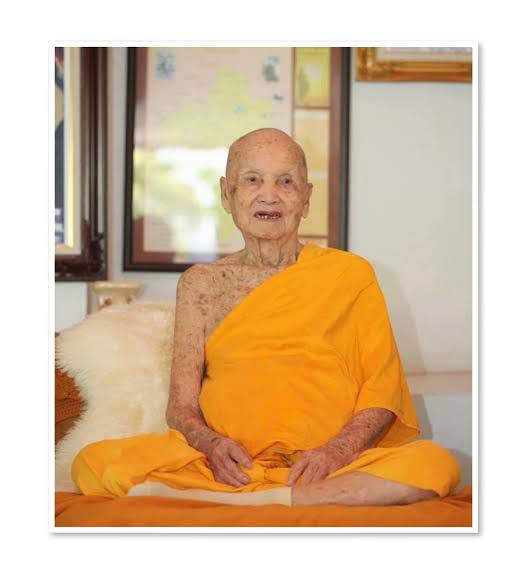
In the serene heartland of Ayutthaya, Thailand, lies Wat Sakae, a historic monastery forever associated with the venerable Luang Pu Dooh Prommapanyo (หลวงปู่ดู่ พรหมปัญโญ). Born in 1904, Luang Pu Dooh ascended to become one of Thailand’s most revered meditation masters, spiritual guides, and creators of sacred amulets (พระเครื่อง), particularly those depicting Phra Prom (พระพรหม), or Brahma. His profound teachings, rooted in the core principles of Puttanussati and the Triple Gem, guided countless practitioners toward inner peace and spiritual realization. Rather than emphasizing mere ritualism, Luang Pu Dooh dedicated his life to teaching the path of mindfulness, establishing a spiritual lineage that remains highly active today.
The Venerable Luang Pu Dooh: A Life Dedicated to Dharma
Early Life and Ordination
Born as Dooh Prompan on May 10, 1904 (or April 29, 1904, in some lunar calendars), at Ban Khao Mao, Tambon Khao Mao, Amphoe Uthai, Changwat Phra Nakhon Si Ayutthaya, the young Dooh experienced tragedy early in life, losing both parents by the age of four. He was raised by his grandmother and sister, receiving his early education at the temple schools of Wat Klang Klong Sabua, Wat Pradu Songtham, and Wat Niwet Thammaprawat.
On May 10, 1925, at the age of 21, he received full ordination as a bhikkhu (monk) at Wat Sakae. His ordination was presided over by the legendary Luang Por Glan of Wat Prayatikaram as his preceptor (Phra Upatchaya), with Luang Por Dae (Abbot of Wat Sakae) as his first ordination teacher (Phra Kammawachachan) and Luang Por Chay of Wat Klang Klong Sabua as his second ordination teacher (Phra Anusawanachan). He was given the monastic name of “Prommapanyo Bhikkhu” (One of Brahma-like Wisdom). Under their tutelage, Luang Pu Dooh delved deeply into the study of the Pāli Canon, meditation, and ancient Wicha (sacred sciences), developing a unique and highly practical approach to Dhamma integration.
Core Teachings: Puttanussati and the Triple Gem
Luang Pu Dooh’s teachings were characterized by simplicity, directness, and profound meditative insight. At the heart of his philosophy lay the practice of Puttanussati (พุทธานุสสติ), the constant recollection of the Buddha, Dharma, and Sangha—the Triple Gem (พระรัตนตรัย). He taught that true spiritual progress was not found in external ceremonies alone, but in the continuous cultivation of the mind through mindfulness, meditation, and the unwavering remembrance of these sacred principles. For him, every breath was an opportunity to connect with the Buddha within, fostering Samadhi (สมาธิ) (concentration) and Panya (ปัญญา) (wisdom).
He often instructed his disciples with the iconic phrase: “Inside, there is Buddha. Outside, there is Buddha. There is Buddha everywhere.” This profound statement encapsulates his teaching that the essence of enlightenment is inherent within all beings, awaiting discovery through diligent, silent practice.
The Maha Jakkapat Chant: The Great Emperor Prayer
One of Luang Pu Dooh’s most enduring and widely practiced contributions to modern Thai Buddhism is the dissemination of the Maha Jakkapat Chant (คาถามหาจักรพรรดิ), also known as the Great Emperor Prayer. Grounded in the ancient *Mahachomphu Sutta* (Chomphu Phut Sut – ชมพูพูตสูตร), the chant recalls the legend of the Buddha manifesting himself as a magnificent, glorious Universal Emperor (Maha Jakkapat) to humble and teach the arrogant, militaristic King Chomphuphrad. This manifestation illustrated that the spiritual power of the Dhamma infinitely exceeds any worldly, material, or temporal authority.
Luang Pu Dooh popularized this katha not as a magical spell for worldly riches, but as a deep meditative tool to cleanse karma, align the practitioner with the blessings of the Triple Gem, and establish a protective spiritual shield. Disciples chant this daily while holding an amulet and visualizing the Buddha or Luang Pu Thuad, followed by the active transference of merit (Metta) to all spirits, Devas, and suffering beings across the three realms of existence.
The core of the Maha Jakkapat Chant is transliterated as follows:
“Namo Buddhaya / Phra Phuttha Tri Ratana Yan / Maneenoparat / Sisahasasutdhamma / Putto Dhammo Sangho / Tee-dee Putta Booja Dhamma Booja Sangha Booja / Wanthami Thang / Sabbhe Phutta Sabbhe Dhamma Sabbhe Sangha / Balappatta Paccekanam Ca Yang Balang / Arahantanam Ca Tejena / Rakkhang Bandhami Sabbaso / Puttang Prasittimae Dhammang Prasittimae Sanghang Prasittimae”
The Spiritual Bond: Luang Pu Dooh and Luang Pu Thuad
A central pillar of Wat Sakae’s tradition is the profound spiritual connection between Luang Pu Dooh and the legendary 16th-century monk Luang Pu Thuad of Wat Chang Hai. Luang Pu Dooh held Luang Pu Thuad in the highest esteem, viewing him as a highly advanced Bodhisattva who had perfected the Ten Paramis (spiritual perfections) and was destined to attain Buddhahood in the future. Luang Pu Dooh designed and consecrated numerous famous Luang Pu Thuad amulets, urging his followers to utilize them as physical anchors for meditation and mental stabilization.
Within the disciple community, particularly popularized by his living lineage successor Luang Ta Ma (Abbot of Wat Tham Muang Na), it is widely believed that Luang Pu Dooh was a direct incarnation (reincarnation) of Luang Pu Thuad himself, as well as a manifestation of the future Buddha, Maitreya. Below is an objective, multi-perspective comparison of this significant belief:
| Devotional & Lineage Perspective (Wat Sakae & Wat Tham Muang Na) | Orthodox Theravada & Academic Perspective |
|---|---|
|
|
The Genesis of Phra Prom Amulets: A Tool for Inner Realization
While many revered masters created amulets depicting the historical Buddha or protective hermits, Luang Pu Dooh is uniquely celebrated for his Phra Prom (Brahma) amulets. This choice was deeply rooted in his meditative realizations and his emphasis on the Brahmaviharas (พรหมวิหาร 4)—the Four Divine Abodes of Metta (loving-kindness), Karuna (compassion), Mudita (sympathetic joy), and Upekkha (equanimity). The four-faced deity, Phra Prom, perfectly symbolizes these boundless qualities, embodying the enlightened mind.
Luang Pu Dooh viewed his amulets not as magical talismans of superstition, but as psychological and spiritual tools—a physical anchor to focus the mind during the practice of Puttanussati. He intended for them to serve as constant visual reminders to cultivate ethical purity, practice breathing meditation, and internalize the virtues of the Triple Gem. For him, the true power of an amulet lay not in the physical material, but in the pure intentions and mindful practice of the practitioner wearing it.
Crafting Sacred Art: Phong Kammathan and the Relic Phenomenon
The creation of Luang Pu Dooh’s amulets was a deeply sacred, meditative process. He meticulously crafted them using various materials, including:
- Phong Kammathan (ผงกรรมฐาน) / Sacred Powders: Meticulously hand-rolled from limestone chalk, mixed with crushed ancient powder amulets, sacred herbs, flower pollen, and other spiritually charged substances, collected and blessed over decades.
- Consecrated Metals: Including copper, brass, bronze, silver, and gold, melted down from sacred ritual offerings, old coins, and ancient temple bells.
- Phra That (พระธาตุ): In rare instances, tiny relics believed to have belonged to enlightened beings were incorporated directly into the powder matrix, imbuing the amulets with deep spiritual resonance.
A highly unique and celebrated phenomenon in the amulet-collecting world is the spontaneous formation of sparkling white crystals, resembling tiny pearls or salt structures, on the surface of Luang Pu Dooh’s clay and powder amulets over time. Devotees call this “Phra That Khuen” (พระธาตุขึ้น), meaning the relics have manifested. This phenomenon remains a major point of discussion in both devotee and scientific circles:
| Devotional & Supernatural Perspective (Phra That Relic Manifestation) | Scientific & Mineralogical Perspective (Efflorescence) |
|---|---|
|
|
The Enduring Legacy of Wat Sakae and Luang Pu Dooh
Luang Pu Dooh passed away peacefully on January 17, 1990, at the age of 85, having spent 65 rains (*vassa*) in the monkhood. He left behind a spiritual legacy that continues to profoundly shape modern Thai Buddhism. He spent the last several decades of his life residing entirely within the temple grounds of Wat Sakae, refusing to travel, in order to remain completely accessible to the thousands of lay pilgrims who sought his counsel daily.
Today, Wat Sakae in Ayutthaya remains a vital pilgrimage site, and the spiritual network established by his disciple Luang Ta Ma has spread his practices across Southeast Asia. His teachings on self-reliance, the power of one’s own mind, and the daily integration of Dhamma remain timeless. His Phra Prom and Luang Pu Thuad amulets are cherished worldwide, not merely as passive collectibles, but as active catalysts for inner transformation, meditation, and mindful living.
Bibliography / Primary Sources
- Khana Sit Luang Pu Dooh (Disciples of Luang Pu Dooh). (1992). Tamra Prawat lae Watthumongkhon Luang Pu Dooh Prommapanyo (The Official Biography and Amulets of Luang Pu Dooh). Ayutthaya: Wat Sakae Publishing.
- Fine Arts Department of Thailand. (2011). Ayutthaya Monastic Archives: History of Wat Sakae and Its Eminent Masters. Bangkok: Ministry of Culture.
- National Institute of Development Administration (NIDA). (2017). The Sociology of Charismatic Lineages and Amulet Cultures in Central Thailand: A Case Study of Wat Sakae. Academic Dissertation, NIDA Library.
- Royal Thai Government Gazette (Ratchakitchanubeksa). Monastic Title Promotions and Appointments of Ayutthaya Province, B.E. 2530. Announcement No. 104, Section 223.
Frequently Asked Questions (FAQ) & Key Concepts
Q: Who was Luang Pu Dooh of Wat Sakae?
A: Luang Pu Dooh Prommapanyo (1904–1990) was a highly revered Thai Buddhist meditation master of Wat Sakae, Ayutthaya, celebrated for his profound teachings on Puttanussati, his deep spiritual connection to Luang Pu Thuad, and his dissemination of the Maha Jakkapat Chant.
Q: What is the Maha Jakkapat Chant (คาถามหาจักรพรรดิ)?
A: Grounded in the ancient *Mahachomphu Sutta*, the Maha Jakkapat Chant is a famous Buddhist prayer popularized by Luang Pu Dooh. It recalls the Buddha manifesting as a Universal Emperor to teach the Dhamma. It is used as a powerful meditative tool to cleanse negative karma, generate blessings, and transfer spiritual merit to sentient beings across all realms.
Q: Why did Luang Pu Dooh specialize in Phra Prom (Brahma) amulets?
A: He created Phra Prom amulets to symbolize the Brahmaviharas (the Four Divine Abodes: loving-kindness, compassion, sympathetic joy, and equanimity). He intended for these amulets to serve as physical, visual anchors to help practitioners focus during meditation and cultivate these sublime states of mind.
Q: What is the “Phra That Khuen” (relic crystallization) phenomenon?
A: It is the spontaneous growth of tiny, white, pearl-like crystals on the surface of Luang Pu Dooh’s powder amulets. Devotees view this as a supernatural manifestation of sacred relics (Phra That) due to his spiritual purity. Scientists analyze this as efflorescence, where fluctuating humidity causes dissolved calcium sulfate (gypsum) in the plaster to migrate to the surface and recrystallize.
Q: Was Luang Pu Dooh considered an incarnation of Luang Pu Thuad?
A: Within his lineage (especially promoted by Wat Sakae and Luang Ta Ma), Luang Pu Dooh is widely venerated as a direct incarnation of the legendary 16th-century monk Luang Pu Thuad and as a future Buddha (Maitreya). However, orthodox Theravada doctrine does not officially recognize active trace-incarnation systems, and scholars view this as a hagiographical tradition that deepens spiritual connection and authority.
Q: How should one practice under Luang Pu Dooh’s lineage?
A: Practice focuses on Puttanussati (recollection of the Triple Gem), ethical conduct (keeping the Five Precepts), daily chanting of the Maha Jakkapat katha while meditating on a holy image, and the systematic transference of merit to all living and spiritual beings to resolve karmic blockages.