
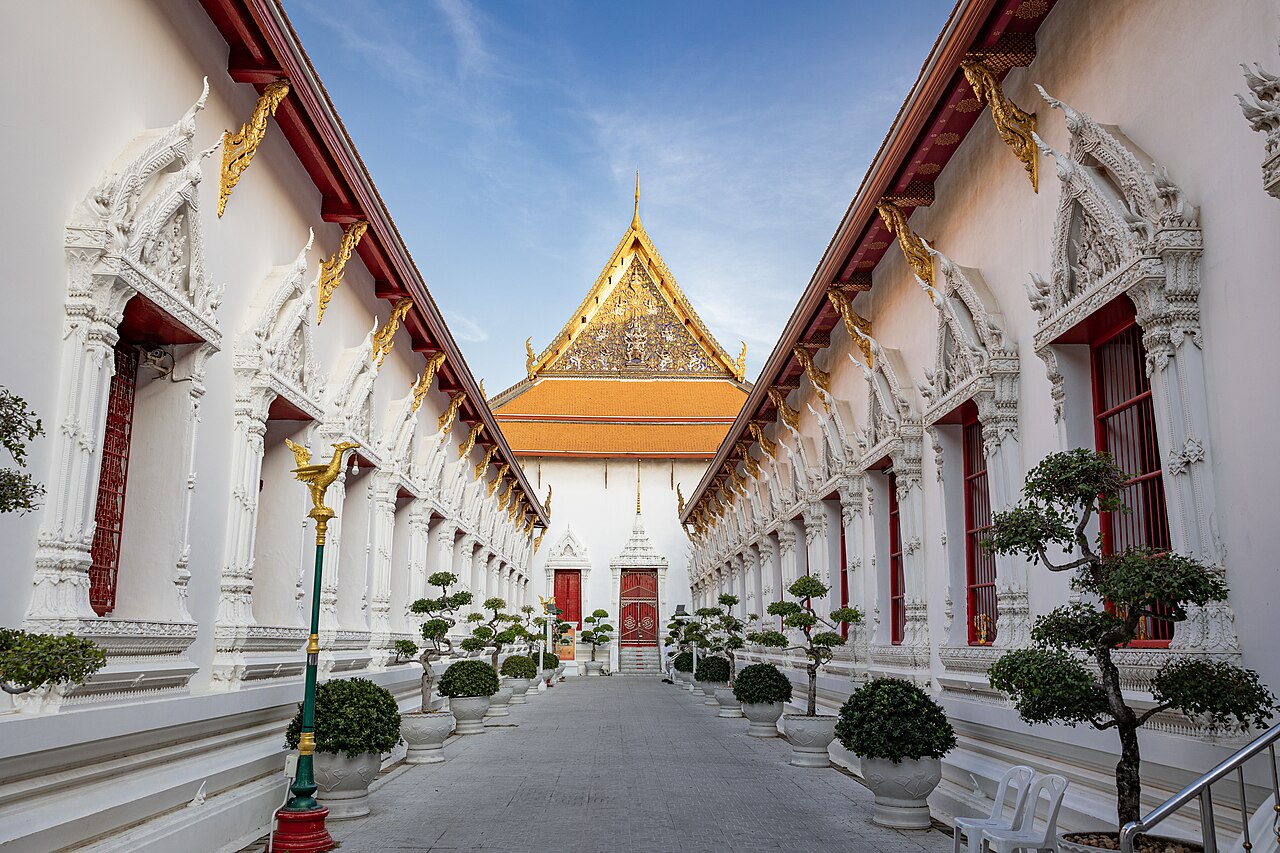
In the bustling heart of Bangkok, amidst the serenity of ancient trees and the quiet dignity of sacred architecture, stands Wat Mahathat Yuwaratrangsarit Rajawarawihan. More than just a magnificent royal temple, Wat Mahathat has, for centuries, served as a foundational pillar of Buddhist learning and spiritual cultivation, profoundly shaping the landscape of Thai Dhamma scholarship and practice.
A Tapestry of History and Royal Lineage
The origins of Wat Mahathat stretch back even before the establishment of Bangkok as the capital of the Rattanakosin Kingdom. Originally known as Wat Salak, this ancient monastery was deemed significant enough to be rebuilt and elevated to a royal temple by King Rama I (Phra Phutthayotfa Chulalok Maharat), the founder of the Chakri Dynasty. Upon the relocation of the capital from Thonburi, King Rama I recognized the temple’s strategic location and spiritual potential. He bestowed upon it the new name, Wat Mahathat, signifying its importance as a “Temple of the Great Relic,” hinting at a possible past connection to enshrining sacred relics, a common practice for temples of high stature.
Its designation as a royal temple of the first class, a rajawarawihan, underscores its integral role within the Thai monarchy and the Sangha (Buddhist monastic community). Throughout the Rattanakosin era, successive monarchs continued to patronize and develop Wat Mahathat, reinforcing its status as a vital spiritual and educational institution.
The Dawn of Modern Buddhist Education: Mahachulalongkornrajavidyalaya University
The most profound legacy of Wat Mahathat as a center for Dhamma studies blossomed under the reign of King Chulalongkorn (Rama V). Recognizing the need to modernize and systematize Buddhist education to preserve and propagate the Dhamma effectively in a changing world, King Rama V established two royal Buddhist universities. In 1887, he founded the Mahachulalongkornrajavidyalaya University (MCU) within the precincts of Wat Mahathat.
MCU was conceived as an institution specifically for educating Buddhist monks, novices, and laypeople in the Tripitaka (the Buddhist scriptures) and advanced academic disciplines. Its establishment marked a revolutionary step, transitioning from traditional monastic learning to a more structured, university-level curriculum. This vision ensured that the Dhamma would be understood not only through rote memorization but also through critical inquiry, philosophical analysis, and practical application. Today, MCU remains one of Thailand’s two state-supported Buddhist universities, a testament to King Rama V’s foresight and Wat Mahathat’s enduring commitment to intellectual and spiritual excellence.
Architecture as Dhamma Expression
The architectural grandeur of Wat Mahathat itself serves as a profound expression of Dhamma. The main Ubosot (ordination hall), adorned with intricate murals depicting Jataka tales and scenes from the Buddha’s life, invites contemplation on impermanence, suffering, and non-self. The towering chedis (stupas) symbolize the Buddha’s enlightened mind and often house relics, offering a tangible focal point for reverence and reflection. Each element, from the serene Buddha images to the detailed craftsmanship, is designed to evoke a sense of peace and inspire practitioners towards deeper understanding and liberation.
Guardians of the Dhamma: Royal Patronage Through Eras
The continuous royal patronage has not only preserved the physical structure of Wat Mahathat but also its spiritual integrity. The temple has historically been the residence of many Supreme Patriarchs of Thailand, further cementing its role as a leading authority in the Sangha. The royal support facilitated the translation and preservation of Buddhist scriptures, the training of highly learned monks, and the dissemination of the Dhamma to the wider populace. This symbiotic relationship between the monarchy and the Sangha, with Wat Mahathat at its core, has been instrumental in maintaining the purity and vitality of Thai Buddhism.
A Living Sanctuary: Practice and Preservation
Beyond its historical and academic significance, Wat Mahathat remains a vibrant center for spiritual practice. It is particularly renowned for its Vipassana (insight) meditation center, drawing practitioners from across Thailand and beyond. Here, the teachings on mindfulness and self-observation, directly inherited from the Buddha’s path to awakening, are diligently taught and practiced. The serene atmosphere of the temple provides an ideal environment for introspection, allowing individuals to cultivate inner peace and wisdom.
Wat Mahathat also hosts numerous Dhamma talks, ceremonies, and festivals throughout the year, ensuring that the ancient wisdom of the Buddha remains accessible and relevant to contemporary society. It stands as a living testament to the enduring power of the Dhamma, continuously inspiring generations towards enlightenment.
Conclusion
Wat Mahathat Yuwaratrangsarit is far more than an ancient edifice; it is a sacred institution where history, spirituality, and scholarship converge. As a royal temple, a birthplace of modern Buddhist education through MCU, and a beacon for Vipassana meditation, it embodies the very essence of Dhamma preservation and propagation in Thailand. Its serene grounds continue to invite seekers to delve into the profound teachings of the Buddha, fostering wisdom and compassion in a world ever in need of their light.
Frequently Asked Questions (FAQ) & Key Concepts
Q: What is the primary historical significance of Wat Mahathat Yuwaratrangsarit?
Wat Mahathat Yuwaratrangsarit is historically significant as one of Thailand’s oldest royal temples, rebuilt and elevated by King Rama I, and most notably as the founding site of Mahachulalongkornrajavidyalaya University (MCU), a leading Buddhist university established by King Rama V.
Q: What is Mahachulalongkornrajavidyalaya University (MCU) and its connection to the temple?
MCU is one of Thailand’s two state-supported Buddhist universities, founded within Wat Mahathat by King Rama V in 1887. It was established to modernize and systematize Buddhist education for monks, novices, and laypeople, making Wat Mahathat a pivotal center for advanced Dhamma studies.
Q: Does Wat Mahathat Yuwaratrangsarit offer meditation courses or practice?
Yes, Wat Mahathat is renowned for its active Vipassana (insight) meditation center, offering instruction and guidance to both monastics and lay practitioners seeking to cultivate mindfulness and wisdom through direct experience.
Q: What does “Rajawarawihan” signify in the temple’s full name?
“Rajawarawihan” signifies that Wat Mahathat is a “first-class royal temple,” indicating its highest possible status among royal temples in Thailand and its direct patronage by the monarchy.
Q: How has royal patronage influenced Wat Mahathat’s role in Thai Buddhism?
Royal patronage has been crucial, providing resources for its architectural development, fostering its role as a leading educational institution (MCU), ensuring the preservation of Buddhist scriptures, and supporting the training of influential Buddhist leaders, thus cementing its spiritual and academic authority.