Somdej Toh: The Saint of Rattanakosin and the True Story Behind the King of Thai Amulets
The Monk Who Still Walks in Thai Memory
On the banks of the Chao Phraya River, where temple bells echo across the water at dawn, there stands Wat Rakang Kositaram. Devotees step softly into its grounds, carrying incense, flowers, and whispered prayers.
They do not come only to worship the Buddha.
They come for Somdej Toh.
More than 150 years after his passing in 1872 (B.E. 2415), Somdej Phra Buddhachan (Toh Brahmaramsi) remains one of the most powerful spiritual presences in Thailand. His life stands at the intersection of court Buddhism, popular devotion, sacred chanting, and what is today a multi-billion-baht amulet economy Deep Research Backing Conversat….
But who was he really?
Was he a royal son?
A scholar-monk?
A miracle worker?
The creator of the most valuable amulet in Thailand?
The truth — like most things in Thai religious history — lies somewhere between archive and legend.
Let us walk through his story.
A Child Born at the Dawn of Rattanakosin
Somdej Toh was born in B.E. 2331 (approximately 1788 CE) Deep Research Backing Conversat… — in the early years of the Rattanakosin Kingdom, when Siam was rebuilding itself after the fall of Ayutthaya.
His birth itself is surrounded by mystery.
Some traditions claim royal parentage. Others disagree. Even early compilations preserve multiple versions rather than one confirmed account Deep Research Backing Conversat…. For serious students of Thai history, this is important: the uncertainty is part of the tradition.
What is clear is this:
From a young age, Toh showed extraordinary intelligence and spiritual inclination. He entered monastic life and quickly distinguished himself not only in meditation but in Pali scholarship — a rare combination that would define his legacy.
Rising Through the Sangha: “Phra Thep Kawi (To)”
Mid-19th century Bangkok was not the sleepy canal city we imagine today. It was a kingdom modernising under King Mongkut (Rama IV), who himself had spent 27 years as a monk before ascending the throne.
During this period, Somdej Toh appears in important compilations under the senior monastic title:
Phra Thep Kawi (To) Deep Research Backing Conversat…
This title signals high ecclesiastical rank and institutional authority.
Even through degraded archival OCR, he is repeatedly described as:
- Organising and presiding over major temple construction projects
- Serving in elite ordination roles
- Acting in ceremonial capacities involving high-status patrons Deep Research Backing Conversat…
This places him not merely as a village monk with mystical abilities — but as a court-facing religious authority embedded within the institutional heart of Siam.
He was not outside the system.
He was at its centre.
Wat Rakang: The Bell That Echoed Across History
As abbot of Wat Rakang Kositaram, Somdej Toh transformed the temple into one of the most spiritually influential sites in Thailand.
The name “Rakang” means bell — and in many ways, his teachings became a bell whose resonance continues today.
But Wat Rakang was not his only sphere of influence.
Archival references link him strongly with major religious works at Wat Ket Chaiyo (Wat Chaiyo) in Ang Thong Province Deep Research Backing Conversat…. He appears as a key organiser and presiding monk during significant temple projects there.
This is important for amulet historians, because Chaiyo later becomes part of the “Three Somdej Temples” narrative — alongside Wat Rakang and Bang Khun Phrom.
The Murals That Still Speak
If you truly want to encounter Somdej Toh’s life story, do not only read books.
Go to Wat Intharawihan.
Biographical murals depicting his life are preserved there Deep Research Backing Conversat…. These murals function as visual archives — religious memory painted on temple walls.
They remind us that Thai religious history is not stored only in documents, but in art, ritual, and living spaces.
The Jinapañjara (Chinabanchorn) Connection
One of the most widely recited protective chants in Thailand is the Jinapañjara Gāthā (Chinabanchorn).
Many devotees believe Somdej Toh composed it.
The historical picture, however, is more nuanced.
Scholarly research on extra-canonical paritta traditions suggests that the Jinapañjara evolved over time through transmission, compilation, redaction, and popularisation Deep Research Backing Conversat…. Modern academic work documents how chanting Jinapanjara became a powerful revival phenomenon in Thailand Deep Research Backing Conversat….
This suggests something subtle but profound:
Somdej Toh may not have “invented” the chant — but he became one of its most powerful transmitters and popularisers.
And in Thai Buddhism, transmission is power.
The Magical Monk and Mae Nak
In Thai popular imagination, Somdej Toh is inseparable from the legend of Mae Nak Phra Khanong — the famous ghost story of Bangkok.
Scholarly analysis treats these stories not as courtroom evidence, but as cultural memory Deep Research Backing Conversat….
In these narratives, Somdej Toh is portrayed as:
- A monk of immense spiritual authority
- Capable of subduing restless spirits
- A moral teacher unafraid to confront power
These stories endure because they dramatise Buddhist virtues:
Compassion.
Wisdom.
Fearlessness.
Whether literal or symbolic, they reinforce his image as a monk of extraordinary attainment.
The Creation of Phra Somdej
Now we arrive at the heart of modern fascination.
Phra Somdej Wat Rakang.
Modern taxonomy widely attributes the most famous Somdej amulets to Somdej Toh in the late 1860s to early 1870s Deep Research Backing Conversat….
These amulets typically feature:
- A seated Buddha in meditation
- One to three-tiered base
- An arch framing the Enlightened One
- Minimalist design of profound symbolic depth
But here is where serious collectors must be careful.
The historical documentation of workshop ledgers, mould counts, and production records is limited Deep Research Backing Conversat…. Many claims — such as fixed mould numbers or “master blocks” — belong more to collector literature than to verified 19th-century records Deep Research Backing Conversat….
This does not mean the amulets are not powerful.
It means the story is more complex than market mythology.
The Three Somdej Temples
Modern collectors often speak of the “Sam Somdej” — the Three Somdej temples:
- Wat Rakang (Bangkok)
- Bang Khun Phrom
- Wat Ket Chaiyo (Ang Thong)
Media discussions explicitly treat Chaiyo as one of the three famous Somdej lines attributed to Somdej Toh Deep Research Backing Conversat….
However, attribution varies in strength.
Serious authentication requires:
- Provenance chains
- Physical examination
- Comparison with documented exemplars
- Conservative evaluation protocols Deep Research Backing Conversat…
The market rewards the label “Somdej Toh.”
Therefore caution is wisdom.
The Multi-Billion Baht Amulet Economy
Somdej Toh’s name is inseparable from Thailand’s amulet market.
Media reports citing Kasikorn Research Centre estimates place the Thai amulet market (Thai buyers alone) in the range of 17–23 billion baht in 2019, with earlier reporting already describing over 22 billion baht in 2007 Deep Research Backing Conversat….
This tells us something important:
The commodification of sacred objects is not new. It is deeply embedded in Thai religious culture.
Scholars of Thai popular Buddhism argue that efficacious monks and objects operate within modern economies rather than outside them Deep Research Backing Conversat….
Somdej Toh stands at the centre of that phenomenon.
His Passing — And the Continuation of Memory
Somdej Toh passed away in B.E. 2415 (1872 CE) Deep Research Backing Conversat….
But his death did not end his influence.
In 2023, official commemorations marked 151 years since his passing, including ceremonies and consecrations of commemorative sacred objects Deep Research Backing Conversat….
He remains:
- Ritually invoked
- Publicly commemorated
- Market-revered
- Academically studied
Few monks achieve such layered continuity.
What Makes Somdej Toh Unique?
When we separate myth from archive, something remarkable remains.
He was:
- A senior titled monk embedded in elite networks Deep Research Backing Conversat…
- A presiding figure in major temple construction projects Deep Research Backing Conversat…
- Associated with protective chanting traditions Deep Research Backing Conversat…
- Central to Thailand’s most prestigious amulet lineage Deep Research Backing Conversat…
- A living character in Thai narrative imagination Deep Research Backing Conversat…
That combination is extraordinarily rare.
The Deeper Lesson Behind the Amulet
Collectors often ask:
“How much is a real Somdej worth?”
But perhaps the better question is:
“What does Somdej Toh represent?”
His life teaches:
- Authority grounded in scholarship
- Power balanced with humility
- Devotion intertwined with institutional responsibility
- Spiritual charisma that survives modernity
The simple seated Buddha on a Somdej amulet reflects inner stillness.
And behind that image stands a monk who bridged court and commoner, archive and legend, devotion and economy.
Conclusion: The Saint Who Became a System
Somdej Toh is not merely a historical monk.
He is:
- A pillar of Thai religious memory
- A symbol of protective Buddhism
- The anchor of the Phra Somdej tradition
- A figure who embodies how Thai spirituality adapts across centuries
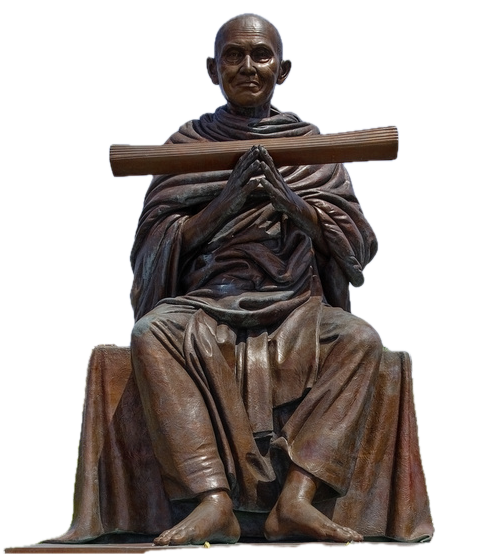
In the quiet halls of Wat Rakang, incense smoke still rises before his statue.
Outside the temple walls, auction houses and collectors debate mould lines and surface cracks.
Between those two worlds — devotion and valuation — stands the enduring legacy of Somdej Phra Buddhachan (Toh Brahmaramsi).
And perhaps that is his greatest miracle:
Not a ghost subdued.
Not a mould pressed.
But a presence that continues to shape Thai Buddhism — institutionally, ritually, and economically — more than 150 years after his passing