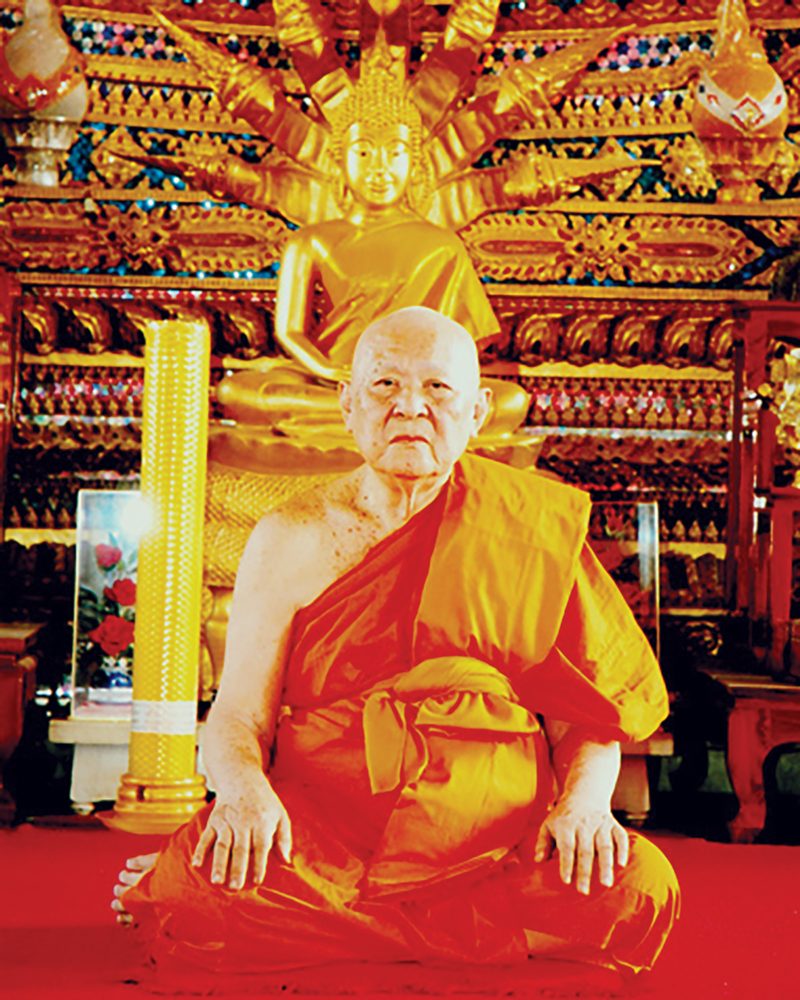
Luang Phor Lum (หลวงปู่หล่ำ สิริธมฺโม, also transliterated Luang Pu Lam or LP Lum) was a Thai-Chinese master monk who lived from 1929 to 2019 (BE 2472–2562) and was the founder and first abbot of Wat Samakkhitham in Lat Phrao, Bangkok. He is best known in the amulet world as the great modern master of the tukkae — the sacred gecko charm for wealth and trade — a craft he inherited as the foremost disciple of Luang Phor Khruen of Wat Sangkho in Suphan Buri. His formal ecclesiastical title was Phra Khru Sirithammarat.
Because his name (หล่ำ) sits awkwardly in English, you will see it written Lum, Lam or Lhum; all refer to the same monk of Wat Samakkhitham (sometimes spelled Wat Samakkeetham), the temple he built with his own hands in Soi Lat Phrao 64, Wang Thonglang district.
Who Was Luang Phor Lum?
In a city of grand royal monasteries, Luang Phor Lum represented a different ideal: the builder-monk who dug the foundations of his own temple by night and climbed its roof beams by day, and who served his neighbourhood as healer, teacher and maker of protective charms for half a century. The Khaosod amulet column remembered him as “a strict and virtuous gaeji ajahn, a refuge for villagers and devotees, with a heart full of metta.” Devotees in Thailand and Singapore venerated him in life, and his sacred objects remain keenly collected today.
Early Life
He was born Lam Sae-Jeng (หล่ำ แซ่เจ็ง) on 31 August 1929 (BE 2472), in Bang Ya Phraek subdistrict, Phra Pradaeng district, Samut Prakan province, to a Thai-Chinese family; his father was Juy Tiang Sae-Jeng and his mother Pin Sae-Sim. His mother died when he was seven, and he was raised largely by his grandparents. He finished fourth grade at the Wat Laem community school and left to help the family work their orchard.
Even as a layman he was drawn to the sacred sciences. In his free hours he studied the Khom (Khmer) script — the script of Thai magical manuscripts — with Phra Ajahn Chat Phasuko of Wat Bang Ya Phraek, a monk who was also his uncle, mastering both reading and writing. So precocious was his gift that, while still a boy, he was said to be able to charm ivy-gourd tendrils into curling around his fingers.
Ordination and His Masters
On 25 April 1949 (BE 2492), aged twenty, he was ordained at Wat Bang Ya Phraek, Samut Prakan, with Phra Khru Sirisilakhun, the ecclesiastical head of Samut Prakan province, as preceptor, and received the monastic name Sirithammo. He passed nak tham tri (first-level Dhamma studies) the following year and began meditation training under the lay teacher Ajahn Arb Somsanit.
Three streams of the old Thai esoteric tradition met in him:
- Luang Phor Phoei Thanangkaro, abbot of Wat Bang Ya Phraek and his ordination teacher, transmitted to him traditional medicine, yantra lore, astrology and the consecration of charms, eventually entrusting the elderly master’s entire workload — including amulet-making — to his young disciple.
- Through the lay master Ajahn Pan Nonta he inherited teachings in the line of the legendary Luang Pu Suk of Wat Pak Khlong Makham Thao — among them the underwater takrut method, the sesame-oil incantation, the “encompassing-the-universe” yantra-blowing and the na na thong inscription.
- From Luang Phor Lim (Kong Lim) of Wat Noi, Chonburi he received the old science of tiger magic, the root of his later tiger amulets.
- Most famously, while on thudong through Suphan Buri he became the foremost disciple of Luang Phor Khruen of Wat Sangkho, the originator of the modern gecko charm.
Luang Phor Khruen tested him by having him consecrate geckos while the old master sat in meditation behind the ceremony. The whole flock came alive — some walking, some leaping, some calling out as though they were real — until the old master could not contain himself and blurted, “Lam, you do it just like me.” The Khaosod column records the master’s deathbed words:
“Lam, my child, I am going now. All of my knowledge has been passed to you. From now on, help the people in my place.”
Building Wat Samakkhitham
From his first rains retreat he practised thudong wandering, and around BE 2505 (1962) he settled at Wat Phra Kraisi Noi in Bang Kapi, becoming well known across the Bang Kapi and Lat Phrao areas. He also helped establish a forest monastery at Khlong Bang Ping in Samut Prakan. Then the laity of Lat Phrao invited him to build a temple of their own. From around BE 2510 (1967) he raised Wat Samakkhitham (originally named Wat Mai, the “new temple”) out of the rice fields of Soi Lat Phrao 64 quite literally with his own hands — digging earth by night, roofing kuti by day. The temple received its royal wisungkhamsima boundary grant in BE 2517 (1974), and its ordination hall was completed in BE 2530 (1987). In BE 2522 (1979) he was granted the royal title Phra Khru Sirithammarat.
Miracle stories drew a devoted following from Singapore, whose disciples invited him to teach there every year and helped fund the temple’s growth. He also supported the building of temples in Chanthaburi, Rayong and Nakhon Ratchasima, along with hospitals and schools. He urged everyone, lay or ordained, to chant daily — his constant texts were the Karaniya Metta Sutta and the Mettanisamsa — a practice you can explore on our chants page.
Amulets of Luang Phor Lum
His earliest sacred objects were blessed photographs (the “white screen” and “black screen” prints) issued while he was helping at Khlong Bang Ping. In BE 2508 (1965) he created his celebrated Phra Pidta, mixing roughly three hundred kinds of flower pollen and blackboard powder — and, extraordinarily, his own blood, offered as an act of devotion to the religion. The temple preserves a rhyme that sums up his most famous creations:
Thao Wessuwan most sacred, the Pidta full of power, the gecko renowned, the waist cord supremely potent, and wishes granted by Mae Nang Tukta.
Among his charms one stands apart: the underwater takrut (takrut tai nam). To make each one, Luang Phor Lum lowered himself beneath the water and inscribed the metal sheet with an iron stylus in a single unbroken sitting, from the first syllable to the last. If the inscription was interrupted at any point the rite was void and had to begin again — a discipline that kept finished pieces few and highly prized.
Collectors seek out in particular:
- Tukkae (gecko) charms — his signature, in wood and other materials and in several sizes, carried by traders for wealth, luck and customer attraction, in the direct lineage of Luang Phor Khruen.
- Underwater takrut (takrut tai nam) — inscribed submerged in a single unbroken rite, the most revered of his takrut.
- Bia setthi and bia gae — consecrated cowrie-shell charms for fortune and protection from black magic; the bia setthi follows the “Kru Pu Rishi” formula, the shell packed with consecrated silver, sealed with chan-rong resin over sacred powder and an embedded takrut, and issued in a coded edition of 680 pieces.
- Phra Pidta — especially the BE 2508 blood-mixed batch.
- Thao Wessuwan images, waist cords (chueak khat eo) and Mae Nang Tukta dolls — all consecrated with inscriptions he made personally; the temple’s Thao Wessuwan was issued in three heights of 14, 5 and 2 inches.
- Tiger amulets (suea dam) — black tigers carved from ordination-hall pillar wood and ringed with yantra, from his tiger-magic lineage.
- Crocodile charms and takrut khongkraphan — fired-clay crocodiles inlaid with gems and takrut for trade and wealth, alongside invulnerability takrut.
Like the charms of other modern masters such as Luang Phor Koon of Wat Ban Rai, genuine pieces are increasingly imitated, so compare references and buy from sellers you trust. We keep a selection of authenticated pieces in our shop, alongside our wider amulet guides.
His Passing and Legacy
Luang Phor Lum passed away peacefully at 03:40 on Friday 22 March 2019 (BE 2562), aged 90, after 70 rains as a monk. Wat Samakkhitham has since built a mondop shrine in his honour, where his image is venerated. Leadership of the temple later passed to Phra Maha Wibun Kitchasaro as abbot; a Dhamma teacher rather than a holder of the esoteric arts, he did not inherit Luang Phor Lum’s witcha or amulet-making, but carries forward the master’s teachings on diligence, chanting and the trained mind. His often-quoted reflection — that we squander half our lives sleeping and should hurry to do good with the half that remains — still circulates among his devotees.
Frequently Asked Questions
Who was Luang Phor Lum?
Luang Phor Lum, or Luang Pu Lam Sirithammo (1929–2019), was the founder and first abbot of Wat Samakkhitham in Lat Phrao, Bangkok. Formally titled Phra Khru Sirithammarat, he was a renowned maker of gecko wealth charms, Pidta amulets and cowrie-shell charms.
What is the tukkae or gecko amulet?
The tukkae is a Thai charm in the form of a gecko, consecrated to attract wealth, customers and good fortune — the gecko’s call is considered a lucky omen. Luang Phor Lum inherited the craft from Luang Phor Khruen of Wat Sangkho and became its most famous modern exponent.
What is Luang Phor Lum’s underwater takrut?
The underwater takrut (takrut tai nam) is among his most revered charms. He made each by lowering himself beneath the water and inscribing the metal sheet in a single unbroken sitting; any interruption voided the rite and forced him to start over. He inherited the method through the Luang Pu Suk lineage of Wat Pak Khlong Makham Thao.
Is it spelled Lum, Lam or Lhum?
All three appear in English. The Thai name หล่ำ has no exact Roman equivalent, so dealers write LP Lum, LP Lam or Luang Pu Lhum interchangeably. They all refer to the same monk: Phra Khru Sirithammarat (Lam Sirithammo) of Wat Samakkhitham, Bangkok.
What amulets is Luang Phor Lum famous for?
His most celebrated creations are the gecko (tukkae maha lap) charms, the underwater takrut (takrut tai nam), bia setthi and bia gae cowrie charms, the BE 2508 Phra Pidta mixed with his own blood, Thao Wessuwan images, black tiger amulets, consecrated waist cords and Mae Nang Tukta dolls, all inscribed and blessed by his own hand.
Where is Wat Samakkhitham?
Wat Samakkhitham (Wat Samakkeetham) is in Soi Lat Phrao 64, Phlapphla subdistrict, Wang Thonglang district, Bangkok. Founded around 1967 and built largely by Luang Phor Lum himself, it houses a mondop shrine to the master and still distributes amulets in his tradition.
Sources
- Luang Pu Lam Sirithammo, Wat Samakkhitham, Bangkok — Khaosod amulet column (Ariya Lok Thi 6)
- First abbot: Luang Pu Lam Sirithammo — Wat Samakkhitham official website
- Luang Pu Lam Sirithammo of Wat Samakkhitham, master of the gecko charm — Kampeenews
- Biography of Luang Phor Lam, Wat Samakkhitham, Wang Thonglang, Bangkok — PNT19 amulet biography
- Luang Pu Lam, Wat Samakkhitham — underwater takrut and bia setthi details (Nutcha Amulet collector reference)