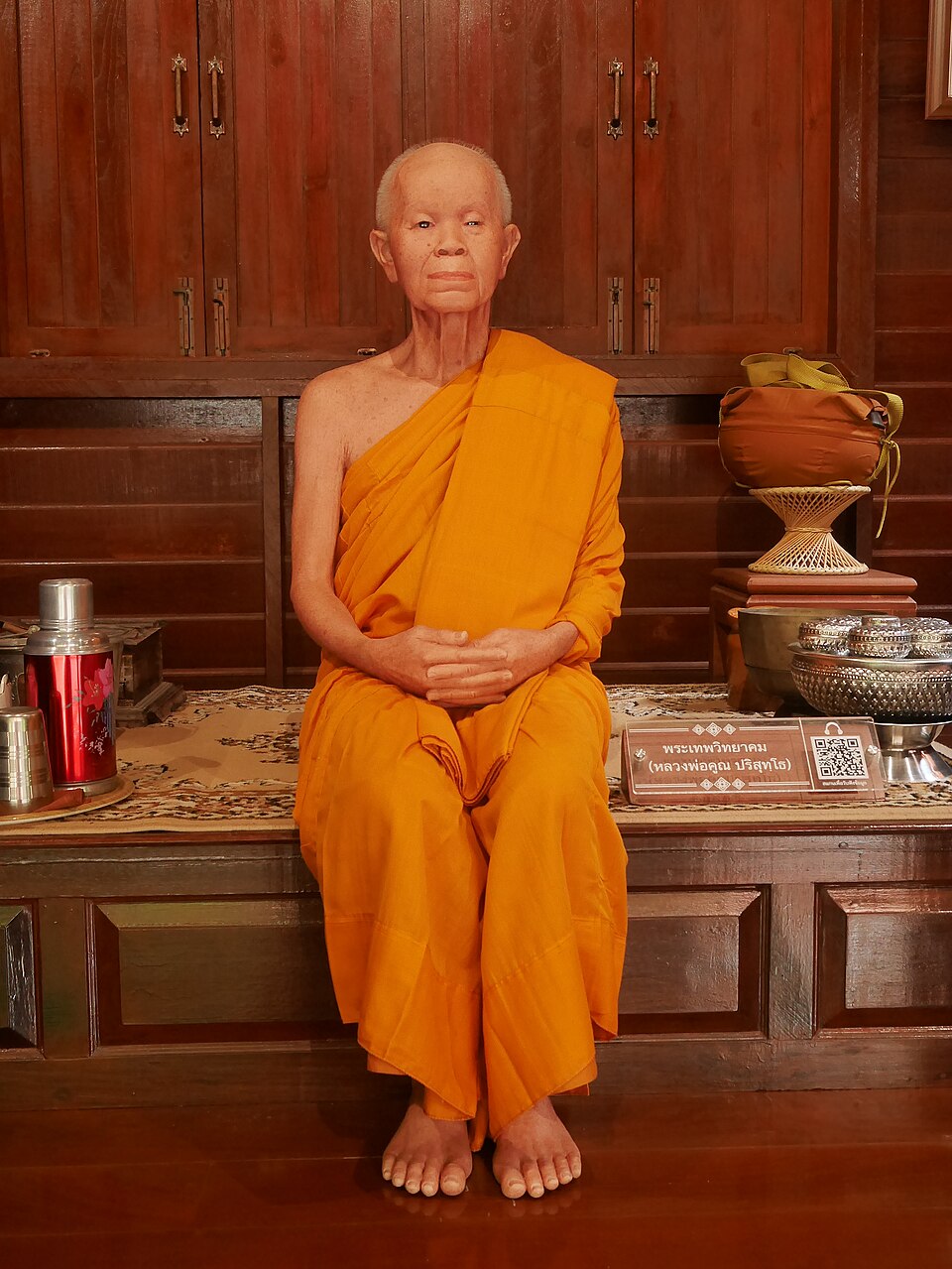
Few monks in modern Thai history have been loved as widely, or as personally, as Luang Phor Koon Parisuttho (หลวงพ่อคูณ ปริสุทฺโธ) of Wat Ban Rai in Dan Khun Thot district, Nakhon Ratchasima. For decades, the image of a small, wiry monk squatting flat-footed on a bench, a hand-rolled cheroot between his fingers, blessing visitors by rapping them on the head with a rolled fan, was one of the most recognisable in Thailand. He addressed prime ministers and farmers alike with the blunt village pronouns ku and mueng (“I” and “you” in the roughest country register), and when asked why, he answered that it showed he was sincere: “It means I love you like my own children and grandchildren — nothing to do with rank or title.” Even the squatting, he explained with typical practicality, was simply how country people sat before there were chairs — “it’s quick, it’s agile, and I’m used to it.” Behind the rustic manner stood a monk of formidable discipline whose amulets financed one of the largest charitable programmes ever undertaken by a single Thai temple.
Early Life and Ordination
Luang Phor Koon was born Koon Chatphonkrang (คูณ ฉัตร์พลกรัง) on Thursday 4 October 1923 (BE 2466) in Ban Rai village, Mu 6, Kut Phiman subdistrict, Dan Khun Thot, Nakhon Ratchasima, the eldest child of Boon and Thongkhao Chatphonkrang, a farming family of modest means. He had two younger sisters, Khamman and Thonglor. His childhood was marked by loss: his mother died when he was around eleven, and his father then placed him in the care of the monks of Wat Ban Rai. There three teachers — Phra Ajarn Chuam Wirotho (the temple’s first abbot, for Wat Ban Rai had been founded around 1893/BE 2436 in the reign of King Rama V), Phra Ajarn Chai and Phra Ajarn Lee — taught him to read Thai and Khmer script and introduced him early to the protective incantations and esoteric lore of the Korat countryside.
As a young man he laboured in his uncle’s rice fields until, one day, aching from head to foot, he lay down on a paddy dyke and heard his aunt remark that if he couldn’t manage the work he might as well go and ordain. His reply became family legend: “Just you watch, auntie — once I’m ordained I promise I’ll never disrobe. I’ll stay in the robes until I die.” He kept his word for seventy-one years.
On 5 May 1944 (BE 2487), aged twenty-one, he was ordained in the consecrated hall of Wat Thanon Hak Yai in Kut Phiman, with Phra Khru Wijahn Dee Kit, the former ecclesiastical head of Dan Khun Thot district, as his preceptor and Phra Ajarn Suk of Wat Khok Rak as his kammavacacarya. He received the monastic name Parisuttho — “the completely pure one.” He studied first under Luang Phor Daeng of Wat Nong Pho, a respected master of vipassana meditation, and then under Luang Phor Khong Phutthasaro — a close friend of Luang Phor Daeng with whom the older monk regularly exchanged both Dhamma and occult knowledge — who pushed the young monk into thudong, the austere wandering practice of the forest tradition. Luang Phor Koon spent years walking the wilderness of the Isan plateau and penetrated deep into the forests of Laos and Cambodia “to strive for release from defilement, craving and clinging,” as he later put it, before returning home through the Surin border country. He had originally intended to stay only three rains-retreats in the robes; what changed his mind, he said, was the poverty he had known: a poor man returning to lay life could barely feed himself, but a monk with knowledge and virtue might lift a whole district.
Building Wat Ban Rai
He returned to Wat Ban Rai, the small village temple of his childhood, in 1952 (BE 2495), and from 1953 (BE 2496) began turning it into a real monastery: an ordination hall, monks’ quarters, a sermon hall, a pond for the village’s water supply, a school for local children. He would remain there, eventually as its abbot and later as advisor to the ecclesiastical governor of Region 11, for the rest of his life — more than sixty years.
His reputation for fearlessness became local legend. In April 1972, when two armed men seized villagers and threatened them with a grenade, Luang Phor Koon walked into the situation unarmed, preached to one gunman about karma until he laid down his weapon, then physically chased down and wrestled the second man — whose pistol, witnesses said, failed to fire — until villagers could hand both over to police. Stories like this, repeated and embroidered across Isan, fused with accounts of soldiers and policemen surviving gunfire while wearing his amulets, and by the 1970s his medals were already travelling in the pockets of Thai and even American servicemen during the Indochina conflict. The people of Korat began calling him Thep Chao Haeng Dan Khun Thot — the god of Dan Khun Thot.
The Monk Who Gave It All Away
From the late 1980s onward, Luang Phor Koon became arguably the most popular monk in Thailand. Wat Ban Rai received rivers of donations, and his amulet editions sold in enormous numbers. What set him apart was what he did with the money: virtually all of it went back out. The temple kept donation ledgers from 1970 (BE 2513) onwards, and when journalists examined them after his death, the recorded giving over those decades came to well over five billion baht — some tallies exceed six billion — making him almost certainly the greatest single monastic donor in Thai history.
The list of named beneficiaries is long and concrete. He built and equipped the Luang Phor Koon Parisuttho Hospital in Dan Khun Thot and donated buildings and medical equipment to Maharat Nakhon Ratchasima Hospital, which treated him for the last twenty years of his life. In education he founded the Luang Phor Koon Parisuttho School and the Luang Phor Koon Parisuttho Technical College (completed in 1997 at a cost of over 400 million baht, today teaching to bachelor’s-degree level); endowed the Luang Phor Koon Parisuttho Education Fund at Suranaree University of Technology in 1993 (BE 2536); created the Luang Phor Koon Education and Sports Fund in 1995 (BE 2538); and set up a separate Wat Ban Rai fund for the schooling of monks and novices. Dozens of village schools, university buildings, police stations and temples across the Northeast carry his name on their dedication plaques.
Royal recognition followed. On 11 January 1995 (BE 2538), His Majesty King Bhumibol Adulyadej and Queen Sirikit travelled to Wat Ban Rai, where Luang Phor Koon presented 72 million baht to royal charities on the occasion of his 72nd birthday; on 18 April 2008 (BE 2551) he was received at Chitralada Royal Villa in Bangkok and presented a further 100 million baht. His often-quoted philosophy was simple: people gave him money to make merit, so it was his duty to pass it on — “the more you give, the more you have.”
Honours from the palace
The crown also honoured the monk himself. On 12 August 1992 (BE 2535) he was raised to the royal ecclesiastical rank of Phra Yan Witthayakhom Thera, a royally appointed elder of the vipassana line; on 10 June 1996 (BE 2539) he was promoted to the ratcha class as Phra Ratcha Witthayakhom; and on 12 August 2004 (BE 2547) to the thep class as Phra Thep Witthayakhom — the title by which he is formally known in death, and which now names the great vihara at his temple. Characteristically, the new names changed nothing about the man: visitors still found him squatting on his bench, speaking ku and mueng.
The blessing of the knock
No image of Luang Phor Koon is more beloved than the head-knock. Faced with thousands — on great days, tens of thousands — of visitors, he abandoned the usual sprinkling of holy water as physically impossible: “If a monk sprinkled water on that many, the whole temple would be soaked,” he laughed. Instead he rapped each bowed head with a rolled-up newspaper or fan, and he insisted the gesture was never empty: with every knock he recited the affirmation sacca saccang adhitthami — “by truth upon truth I resolve it.” “If I knock a hundred heads, I say it a hundred times,” he told an interviewer. “Some people ask me to hit them hard — they say they’ve come a long way for it — so I hit them hard. Others get a gentle tap.” Devotees believed the knock drove away misfortune and illness, and politicians of every party queued for it before elections; photographs of prime ministers bowing under the old monk’s newspaper became a fixture of Thai front pages.
The Amulets of Luang Phor Koon
For collectors, Luang Phor Koon’s catalogue is vast — hundreds of editions spanning nearly five decades — but the market has long agreed on which batches matter most.
His consecration style was as unceremonious as everything else about him. Where other temples staged elaborate multi-day phutthaphisek rituals, Luang Phor Koon often empowered an entire edition in a single sitting, sometimes startlingly brief. “When you consecrate anything,” he explained, “the mind must be in samadhi. When the mind has samadhi, whatever you consecrate is potent.” His method drew on the Khmer-script lore he had learned as a temple boy and refined under Luang Phor Daeng and Luang Phor Khong: the heart-syllables ma a u and na ma pha tha recited forward and in reverse (anulom-patilom), expanded into sixteen syllables with single-pointed concentration. Collectors prize “single-breath” Koon consecrations precisely because the master regarded the state of mind, not the length of the ceremony, as the source of an amulet’s power.
The early coins: BE 2512–2521
His first portrait coin, the rian run raek BE 2512 (1969), was issued not at Wat Ban Rai but at Wat Chaeng Nok in Nakhon Ratchasima city, to commemorate the celebration of that temple’s principal Buddha image on 9 August 1969. Roughly 10,000 copper coins were struck. A charming tradition holds that when demand outstripped supply, Luang Phor Koon threw the remaining coins into the temple pond and told people to dive for them — hence the nickname “the pond-throwing batch.” Clean, original examples now trade for many hundreds of thousands of baht, with championship-grade pieces reaching the million-baht level.
The BE 2517 (1974) coin, issued to fund monks’ quarters at Wat Sa Kaew, was struck in large numbers — nearly 100,000 in copper plus about 2,500 in nawa (nine-metal alloy) — and is the classic “working man’s” Luang Phor Koon coin. Because so many dies were used, it has spawned a whole sub-discipline of block study (the “nawa block,” “block ha taek,” “rain block” and others), and the back carries his horoscope ringed by a Khmer-script maha-ut gun-stopping formula.
The Sang Barami BE 2519 (1976) edition is, by most reckonings, the king of his coins: it was the first major edition struck at Wat Ban Rai itself, beautifully engraved, and made in deliberately small numbers — 2,519 copper, 999 nawa, 199 silver and just 19 gold by the strictest counts (some records say 99). Gold examples have been quoted in the five-to-ten-million-baht range. The BE 2521 Sri Nakhon Bank coin (200 silver, 500 nawa, 5,000 copper), struck for the bank’s Korat branch opening, rounds out the early classics.
The golden era: BE 2536–2538
The years 1993–1995, when Luang Phor Koon’s fame was at its absolute peak, produced the editions most actively traded today. The Charoen Phon Bon BE 2536 (1993) coin — “blessings from above,” with the famous benediction metta maha niyom on the reverse — is widely considered his most beautiful portrait coin; its rarest variants, the uncut “wing” coins with nine code stamps (only 100 each in silver, nawa and copper), are fiercely contested. The same prolific year produced the Phet Nam Ek edition, which he famously empowered in a single unbroken six-hour session through the night of 28 September 1993, and the Khun Phra Thep Prathan Phon edition honouring HRH Princess Maha Chakri Sirindhorn’s visit to Wat Ban Rai.
From BE 2537 (1994) the standout is the Nang Phan Chana Man (“seated on a pedestal tray, conquering Mara”) coin — every piece code-stamped and serial-numbered, its design consciously echoing the celebrated nang phan coins of Luang Pu Tim of Wat Lahan Rai. It remains a favourite of merchants and traders. The Sao Ha (“fifth lunar Saturday”) editions of 2536–2537, including the Sao Ha Khun Phan Lan, and the cheerful prosperity batches of BE 2538 — his 72nd-birthday year, when editions with names like “Ruai Ruai Ruai” (rich, rich, rich) and “Ngern Lan” (millions) poured out to meet unprecedented demand — complete the core of the golden era. Later editions from the late 1990s (BE 2541–2542) and the great BE 2556 (2013) Khun Phra Thep Witthayakhom edition, consecrated by a gathering of senior masters from across Thailand, keep the lineage alive for newer collectors at accessible prices.
Why do collectors prize these pieces so highly? Partly the documented scarcity of the premium metals; partly the unusually rich folklore of protection — Luang Phor Koon’s amulets are the textbook example of klaew klad (escape from harm) and maha-ut faith in the modern era; and partly because every coin is a small receipt for a hospital wing or a classroom somewhere in Isan. With that demand has come an ocean of forgeries, especially of the 2512, 2519 and 2536 editions — serious buyers should insist on certificated examples or established competition provenance.
The Elephant Temple: Thep Wittayakhom Vihara
The most spectacular monument of his last years rose from the temple pond itself. The Thep Wittayakhom Vihara — named for his ecclesiastical title — is a four-storey hall (including one basement level) in the form of a colossal elephant, 42 metres high, standing in a 30-rai lake in the temple’s Dhamma park. Begun in honour of King Bhumibol’s 84th birthday in 2011 (BE 2554) and completed for Luang Phor Koon’s own 90th birthday in 2013 (BE 2556), it is conceived as a “vihara of the Tripitaka,” its storeys narrating the Buddha’s story from the underwater world of the basement to the rooftop terrace, where a large Buddha image sits beside a gold-covered statue of Luang Phor Koon. The building is sheathed in more than twenty million ceramic mosaic pieces — the largest ceramic-mosaic structure in Asia — and much of it was laid by ordinary devotees, each permitted to set no more than one square metre a day so that the work was done with mindfulness as well as glue. A nineteen-headed naga guards the approach. The temple grounds also house the Luang Phor Koon Museum, which preserves his robes, photographs, amulet archives and the story of his life for the busloads of pilgrims who still arrive daily. In 2024 (BE 2567) the temple announced its next landmark: the world’s largest statue of Luang Phor Koon, seated — of course — in his trademark squat.
Death, the Great Teacher, and a Royal Farewell
His giving extended, in the end, to his own body — a decision he made long before he was old. On 6 January 1993 (BE 2536), the 70-year-old monk travelled quietly to the Department of Anatomy at Khon Kaen University’s Faculty of Medicine, toured the dissection laboratories, and declared, in his inimitable register, “I’ll be a great teacher — the kind you cut.” He signed body-donation will number 36/006 on the spot and pronounced “It is accomplished” three times; the will was lightly amended at Wat Ban Rai on 25 June 2000 (BE 2543). His reasoning, recorded in the will itself, was that his corpse must never become a burden or a battleground: the hospital was to collect the body within 24 hours, and the eventual funeral was to be exactly like that of every other donor — no grand ceremony, no relics, no fundraising in his name.
His final decades were a long battle with illness, borne with the same bluntness he brought to everything: a heart attack in 1996 (BE 2539), triple-vessel bypass surgery at Siriraj Hospital in 2000 (BE 2543), emergency brain surgery after a haemorrhage in 2004 (BE 2547) that left him needing a wheelchair, and a severe lung infection in May 2011 (BE 2554) that kept him hospitalised for nine months before doctors sent him home to Wat Ban Rai on 30 January 2012, where a medical team cared for him at the temple. On the morning of 15 May 2015 a collapsed lung stopped his heart; he was rushed to Maharat Nakhon Ratchasima Hospital, where he died peacefully at 11:45 on 16 May 2015 (BE 2558), in his 92nd year, after 71 years in the robes.
The will was honoured to the letter. On 17 May his body was carried in procession to Khon Kaen University, where it lay at the Golden Jubilee Convention Hall through seven days of royally sponsored bathing rites and Abhidhamma chanting (17–23 May 2015) as hundreds of thousands filed past, before being delivered to the Faculty of Medicine as a cadaver for medical students — becoming, in the gentle Thai phrase, an ajarn yai, a “great teacher.” His final donation was himself.
After his will became public, the Faculty of Medicine at Khon Kaen University reported that body-donation pledges roughly tripled — from a few dozen a month to several hundred — a measure of how deeply his last act moved the public.
When his body had served its purpose, the university held the royal-sponsored cremation for Luang Phor Koon together with the year’s other donor “great teachers,” from 21 to 30 January 2019, with the cremation itself on the night of 29 January 2019 at a temporary crematorium at Wat Nong Waeng’s Isan Buddhamonthon grounds in Khon Kaen — a pyre built, in the old Isan manner reserved for great monks, in the form of the mythical nok hatsadiling bird, ritually “slain” before the flames were lit. The next day, as he had instructed, his ashes were scattered in the Mekong River near the submerged stupa of Phra That Klang Nam at Nong Khai. He kept no relics, no golden stupa, no estate — only the hospitals, the schools, the technical college, an elephant-shaped vihara glittering with twenty million tiles, and millions of small metal coins resting against the chests of people who still call him, simply, Phor — father.
Frequently Asked Questions
Who was Luang Phor Koon?
Luang Phor Koon Parisuttho (1923–2015) was the abbot of Wat Ban Rai in Dan Khun Thot, Nakhon Ratchasima, and one of Thailand’s most beloved monks. Famous for squatting on a bench and blessing devotees with a knock on the head, he channelled billions of baht in donations into hospitals, schools and temples across the Northeast.
Why did Luang Phor Koon knock people on the head?
With tens of thousands of visitors on busy days, sprinkling holy water was physically impossible, so he rapped each bowed head with a rolled-up newspaper or fan instead. With every knock he recited the affirmation sacca saccang adhitthami — “by truth upon truth I resolve it” — and devotees believed it drove away misfortune and illness.
Which Luang Phor Koon amulets are the most valuable?
The market prizes his first portrait coin of BE 2512 (1969), the Sang Barami edition of BE 2519 (1976) — whose gold coins have been quoted at five to ten million baht — and the Charoen Phon Bon coin of BE 2536 (1993). Forgeries abound, so certification or competition provenance is essential.
How much did Luang Phor Koon donate to charity?
Wat Ban Rai’s donation ledgers, kept from 1970 onwards, record giving of well over five billion baht — some tallies exceed six billion — funding hospitals, schools, a technical college and temples across the Northeast. He also presented 72 million baht to royal charities in 1995 and a further 100 million in 2008.
What happened to Luang Phor Koon after his death?
He died on 16 May 2015 at Maharat Nakhon Ratchasima Hospital, in his 92nd year. Following his will, his body went to Khon Kaen University as a cadaver for medical students. The royal-sponsored cremation took place on 29 January 2019, and his ashes were scattered in the Mekong River at Nong Khai.
Sources
- Luang Por Khun Parissuddho — Wikipedia (English)
- พระเทพวิทยาคม (คูณ ปริสุทฺโธ) — วิกิพีเดียภาษาไทย
- หลวงพ่อคูณ ปริสุทฺโธ พระนักพัฒนาสร้างทานบารมี — Silpa-Mag (ศิลปวัฒนธรรม)
- หลวงพ่อคูณ กับวัตถุมงคล เครื่องเตือนใจ หรือช่วยให้รอดปลอดภัย — Silpa-Mag
- รวมเหรียญ “หลวงพ่อคูณ” 9 รุ่น แพงและหายาก — สยามรัฐ (Siamrath)
- เหรียญรุ่นแรกปี 2512 หลวงพ่อคูณ : พันธุ์แท้พระเครื่อง — ข่าวสด (Khaosod)
- เหรียญหลวงพ่อคูณ วัดบ้านไร่ ปี ๒๕๑๗ แยกออกเป็น ๙ บล็อก — คมชัดลึก (Komchadluek)
- “หลวงพ่อคูณ” มรณภาพแล้ว อายุ 92 ปี — Thai PBS
- เส้นทางชีวิตสู่ทางธรรม “หลวงพ่อคูณ ปริสุทฺโธ” — Thai PBS
- แรงศรัทธา “หลวงพ่อคูณ” ยอดบริจาคร่างเป็นครูใหญ่เพิ่ม 3 เท่า — Thai PBS
- มรดกธรรมชิ้นสุดท้าย จารึกหลวงพ่อคูณ ผ่านพิธี “ฆ่านกหัสดีลิงค์” — Thai PBS
- เปิดพินัยกรรม “หลวงพ่อคูณ” เขียนก่อนละสังขารปี 2543 — ไทยรัฐ (Thairath)
- ความผูกพันหลวงพ่อคูณ บริจาคร่างกาย มข. ลอยอังคารพระธาตุกลางน้ำ — ไทยรัฐ (Thairath)
- “หลวงพ่อคูณ” เอกลักษณ์ เคาะหัว เพราะท่านว่าคาถากำกับทุกครั้ง — ไทยรัฐ (Thairath)
- เปิดสมุดบริจาค “หลวงพ่อคูณ” ตั้งแต่ปี 2513 ช่วยเหลือสังคมกว่า 6 พันล้าน — มติชน (Matichon)
- พิธีพระราชทานเพลิงศพครูใหญ่ พระเทพวิทยาคม (หลวงพ่อคูณ ปริสุทฺโธ) — Khon Kaen University
- Cascade of love for Luang Phor Koon — Bangkok Post
- ประวัติ “หลวงพ่อคูณ ปริสุทโธ” พระเกจิดังวัดบ้านไร่แห่งเมืองโคราช — PPTV HD36
- วิหารเทพวิทยาคม สถานที่ท่องเที่ยวเชิงศาสนา ณ วัดบ้านไร่ — Kapook Travel
- พิพิธภัณฑ์หลวงพ่อคูณ วัดบ้านไร่ — Tourism Authority of Thailand
- วัดบ้านไร่ สร้างแลนด์มาร์ค “หลวงพ่อคูณ” องค์ใหญ่ที่สุดในโลก — Amarin TV