Ask any Thai collector to name the single most coveted amulet in the country and the answer is almost always the same: Phra Somdej (พระสมเด็จ). Revered as the “King of Thai amulets” and enthroned at the head of the legendary Benjapakee set, this small rectangle of white sacred powder has come to embody the meeting point of Thai Buddhist devotion, history, and artistry. For more than 150 years, it has been worn by royalty, soldiers, merchants, and farmers alike — and today, a fine original example commands prices that place it among the most valuable religious objects in Southeast Asia. The amulet scholar Triyampawai, writing in his classic Pariat Phra Krueang, observed that Phra Somdej became famous within a single year of its creator’s death and has never once declined in popularity since — “a truly remarkable and extraordinary case.”
The Creator: Somdej Phra Buddhacharn (Toh Brahmaramsi)
Phra Somdej is inseparable from the monk who made it. Somdej Phra Buddhacharn (Toh Brahmaramsi), known affectionately throughout Thailand simply as Somdej Toh (1788–1872), remains the most beloved monk of the entire Rattanakosin era. In 1852, King Rama IV appointed him abbot of Wat Rakhang Khositaram, and in 1864 elevated him to the supreme ecclesiastical rank of Somdej Phra Buddhacharn.
It was during his Wat Rakhang years, in roughly the last decade of his life (commonly dated to around B.E. 2409–2415, or 1866–1872), that he created the amulets that bear his title. Tradition holds that he aspired to make 84,000 — one for each section of the Buddhist teachings — though he pressed them personally, a few at a time, drying them and handing them directly to laypeople who came to pay respects. This hands-on, unhurried method is precisely why genuine Wat Rakhang pieces are so refined, consistent, and exceptionally rare.
The Design and Its Symbolism
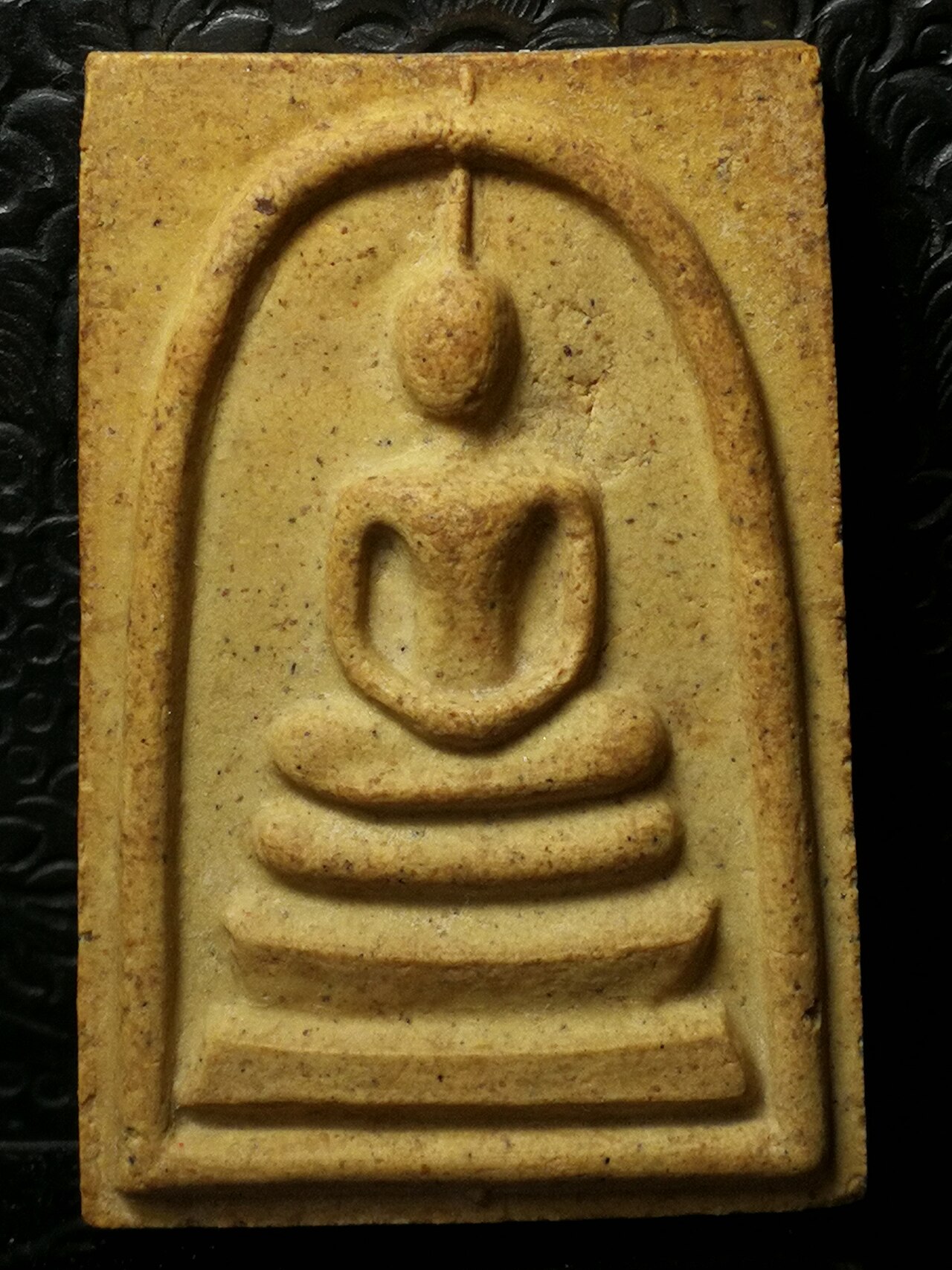
The genius of Phra Somdej lies in its radical simplicity. At a time when most Thai amulets were ornate, the new design was almost abstract: a serene Buddha image, deliberately rendered without facial features, seated in meditation upon a three-tiered throne, the whole enclosed within a rounded arch known as the sum krob kaew — the “crystal-dome arch.”
Collectors read the three tiers as the three worlds of Buddhist cosmology, with the Buddha seated serenely above them all, while the encircling arch evokes the protective dome of the universe — the same imagery of an impenetrable enclosure found in the Chinnabanchorn Gatha that Somdej Toh chanted over his creations.
The Four Classic Moulds (Pims)
- Pim Yai (พิมพ์ใหญ่) — The “grand mould,” the most famous design of all. A genuine Pim Yai is subtly asymmetrical from the topknot down through the body, a signature of hand-carved moulds that forgers struggle to reproduce. No genuine Pim Yai has ever been recorded with carved eyes, nose, or mouth.
- Pim Song Chedi (พิมพ์ทรงเจดีย์) — The “chedi-form” mould, whose arch line is finer than Pim Yai’s. Key details include a sash line (angsa) running from the shoulder beneath the armpit and a small surplus of mass inside the right arm left by the deepest part of the mould.
- Pim Ket Bua Tum (พิมพ์เกศบัวตูม) — Named for its “lotus-bud” topknot, with a fuller, more robust Buddha figure reminiscent of fine U-Thong period sculpture.
- Pim Than Saem (พิมพ์ฐานแซม) — The “inserted-base” mould, in which slender extra lines are interleaved between the throne tiers.
Sacred Powders: What Phra Somdej Is Made Of
Phra Somdej belongs to the nuea phong (sacred powder) family of amulets. Its base is shell lime — seashells burned and slaked into a fine white lime — combined with blessed materials: pulverised temple flowers, alms-round rice, lotus, banana, honey, and old monastery plaster.
The spiritual heart of the recipe is the set of five sacred chalk powders (phong wiset), which Somdej Toh created by writing sacred geometric Yantras on a slate with chalk, erasing them while chanting, collecting the dust, and re-forming it into new chalk through endless cycles:
- Pong Pattamang (ผงปัทมัง): For extreme protection and invulnerability (Kong Krapan Chatree).
- Pong Ittijae (ผงอิทธิเจ): For immense charm, compassion, and loving-kindness (Metta Mahaniyom).
- Pong Maharaj (ผงมหาราช): For authority, prestige, and leadership (Maha Amnat).
- Pong Buddhakhun (ผงพุทธคุณ): For general merit, healing, and spiritual elevation.
- Pong Trinisinghe (ผงตรีนิสิงเห): For defense against black magic, dark spirits, and physical illnesses.
The Role of Tangyu Oil: Early batches cracked easily due to a lack of binder. Chinese Tangyu (tung) oil was introduced as a binder around B.E. 2412 — a refinement that tradition attributes to a royal goldsmith remembered as Luang Vijarn Jayanurak, though no contemporary record of such an official has been found, and some researchers regard the figure as a later embellishment. Searches of the Royal Gazette have turned up no civil servant of that name, and the portrait usually published as him has been identified as an unrelated 19th-century official — which is why a number of historians treat the goldsmith as a mid-20th-century market legend. This bound the sacred powders into a dense, slightly elastic, ivory-colored clay. Over time, this oil seeps to the surface, creating the famous yellowish-brown patina, fine age-cracks (Rak Phak Chi), and shrinking contours that modern experts look for to verify authenticity.
The Great Debate: Mainstream vs. “Wang Na” (Palace) Amulets
Understanding the modern landscape of Phra Somdej requires examining a massive, highly polarized division within the Thai collecting world regarding the authenticity of “Wang Na” (Front Palace) and “Wat Phra Kaew” (Temple of the Emerald Buddha) amulets. The community is split into two primary schools of thought:
| Dimension | Mainstream Standard (สมาคมฯ) | Alternative Palace Standard (วังหน้า / วัดพระแก้ว) |
|---|---|---|
| Core Belief | Somdej Toh made amulets for the general public, primarily distributed at Wat Rakhang, Wat Bang Khun Phrom, and Wat Ket Chaiyo. No decorative ornaments. | Somdej Toh made highly ornate, precious amulets exclusively for royal ceremonies and elite court members. |
| Amulet Style | Minimalist, pure chalk-white or ivory color. Plain backs with natural wear, contraction, and Tangyu oil seepage. No ornaments. | Decorated with gold leaf, red lacquer, jade, porcelain, or embedded with jewels, royal seals (Garuda), or stamped dates (e.g., “2411”). |
| Storage & Provenance | Discovered in temple stupas (Chedis) or passed down through standard family lineages. Verified by age-related physical decomposition. | Stored secretly in royal vaults and chests inside Wat Phra Kaew or the Front Palace (Wang Na), allegedly opened in recent decades. |
| Certification Body | The Amulet Association of Thailand (สมาคมผู้นิยมพระเครื่องพระบูชาไทย), which certifies standard temple molds only. | Parallel bodies such as the **Amulets Siam Association** (สมาคมส่องพระแท้เมืองสยาม) and private research institutions. |
| Market Value | Priceless (ranging from 1 Million to over 50 Million Baht) due to extreme scarcity and rigid market standard. | Collectibly valuable but commercially rejected by mainstream dealers; focuses on spiritual/historical value. |
The Mainstream Arguments Against “Wang Na” Amulets
Mainstream experts reject “Wang Na” and “Wat Phra Kaew” amulets, categorizing them as modern commercial fabrications (“Phra Tha Phrachan” or “Phra Gae”). Their primary arguments are:
- Lack of Historical Documentation: There are zero official court records in the National Archives or Royal Gazette from the reigns of Rama IV or Rama V mentioning Somdet Toh consecrating decorated amulets for the B.E. 2411 royal coronation.
- Anachronistic Dating Formats: Many “Wang Na” amulets have the Thai solar calendar year “พ.ศ. 2411” (B.E. 2411) stamped on the back. Mainstream historians point out that in B.E. 2411 (1868), Thailand did not use the Buddhist Era (พ.ศ.) for dating civil or sacred objects in this manner; instead, they utilized the Chula Sakarat (C.S.) or Ratanakosin Sok (R.S.) dating formats.
- Material Anachronisms: Chemical testing of non-standard “Wang Na” amulets has frequently revealed the presence of modern synthetic resins, plastic polymers, and industrial pigments that did not exist in mid-19th century Siam.
The Alternative Arguments Supporting “Wang Na” Amulets
Proponents of the Palace/Wang Na standard maintain that these amulets are authentic relics of royal ceremonies. Their key arguments are:
- Elite Preservation: Because these amulets were created for royal ceremonies (specifically for the Front Palace Lord, Krom Phra Ratchawang Bowon Wichaichan, and King Chulalongkorn), they were stored in secure palace chests and never distributed to the public. This explains why they were unknown to early commercial dealers.
- The Palm-Leaf Manuscripts: Proponents cite the records of **Luang Pu Kham** (of Wat Amarin) and **Phraya Thip Kosa**, which describe secret Consecration Ceremonies held inside the Grand Palace temple (Wat Phra Kaew) overseen by Somdet Toh.
- The NIDA Chest (September 2023): Proponents point to the historical event of **General Napol Boontap** (former Deputy Royal Aide-de-Camp) donating a collection of authentic, sealed chests containing these royal Phra Somdej amulets to **NIDA (National Institute of Development Administration)** to raise funds for the Sikhio Education Center. The chests were allegedly accompanied by palm-leaf records indicating they were sealed by Somdet Toh and intended to be opened after 12 zodiac cycles (144 years) in B.E. 2566 (2023).
- Commercial Monopoly Critique: Proponents argue that mainstream commercial dealers reject Wang Na amulets simply because they are highly numerous. Accepting them would crash the artificial scarcity of standard Wat Rakhang amulets, destroying the multi-billion Baht monopoly held by commercial cartels.
The Three Great Lineages
1. Phra Somdej Wat Rakhang
The original and supreme lineage: amulets pressed by Somdej Toh’s own hand at Wat Rakhang and given out during his lifetime. Never buried, they show clean surfaces, superb mould definition, and the classic soft white-ivory tone. Today, champion specimens are valued in the tens of millions of Baht, with some legendary pieces exceeding one hundred million Baht in private transactions.
2. Phra Somdej Bang Khun Phrom
In 1870 (B.E. 2413), the royal scribe **Saimian Tra Duang**, patron of Wat Bang Khun Phrom (today Wat Mai Amataros), sought Somdej Toh’s help to create amulets for interment in the temple’s new chedi as a legacy for future generations. Somdej Toh lent his famous Wat Rakhang moulds and contributed his sacred powders.
Because these amulets spent decades sealed inside the damp chedi, they carry *khraap kru* — mineral crusts and calcium deposits from the burial chamber — which are a key identification feature. The crypt was formally opened in November 1957 (B.E. 2500), yielding 2,950 complete Phra Somdej amulets.
3. Phra Somdej Ket Chaiyo
At **Wat Chaiyo Worawihan** in Ang Thong province — his mother’s home region — Somdej Toh created another distinct lineage, made in dedication to his mother Ket and his grandfather Chai. The Ket Chaiyo design is unmistakable: a slimmer, more austere Buddha with a pronounced chest, seated on a throne of **six or seven tiers** rather than three. The amulets came to light when the temple’s colossal Buddha image, built by Somdej Toh, collapsed during a temple renovation in the late 1880s (around B.E. 2430).
Advice for New Collectors
- Study before you spend: Learn the standard pims, the texture of aged shell-lime paste, the visible *muansan* (mass particles), and the natural shrinkage and cracking of 150-year-old powder. Connoisseurs look for “worm-track” marks and fine needle-point pores typical of slow-dried lime paste.
- Insist on certification: For top-tier pieces, buy only with authentication and certification cards from established bodies — above all the **Thai Buddha Image Admiration Association (Samakhom Phu Niyom Phra Krueang Phra Bucha Thai)**, which represents the de facto commercial market standard.
- Consider temple-direct later batches: Wat Rakhang has issued commemorative Phra Somdej editions that are fully documented, properly consecrated, and highly affordable — above all the **100th anniversary batch of B.E. 2515 (1972)** and the **122nd anniversary batch of B.E. 2537 (1994)**. These carry the lineage, the powders, and the blessing of Wat Rakhang at a fraction of the cost.
Frequently Asked Questions (FAQ) & Key Concepts
Q: Who created the Phra Somdej amulet?
Phra Somdej was created by Somdej Phra Buddhacharn (Toh Brahmaramsi), known as Somdej Toh, abbot of Wat Rakhang Khositaram in Bangkok. He pressed the amulets personally during roughly the last decade of his life, around 1866–1872.
Q: What is a Phra Somdej amulet made of?
Its base is shell lime blended with pulverised temple flowers, alms rice, lotus, banana, honey, and old monastery plaster, bound with Tangyu oil. Its spiritual heart is the five sacred chalk powders — Pathamang, Ittijae, Maharat, Trinisinghe, and Puttakun — created by writing and erasing sacred formulas through repeated consecration cycles.
Q: Why are “Wang Na” (Front Palace) amulets controversial?
The “Wang Na” or “Wat Phra Kaew” amulets are controversial because mainstream commercial dealers (the Amulet Association of Thailand) reject them, citing a lack of official court archives, modern synthetic materials in some specimens, and anachronistic calendar stamps (like “B.E. 2411” stamped on the back during an era that did not use that format). Conversely, alternative collectors believe they are authentic relics made for royal ceremonies and kept in secure palace chests, and they claim commercial cartels reject them only to maintain a monopoly over artificial scarcity.
Q: What are the three great Phra Somdej lineages?
Collectors recognise Phra Somdej Wat Rakhang (pressed by Somdej Toh himself and never buried), Phra Somdej Bang Khun Phrom of 1870 (buried in a chedi and excavated in 1957), and Phra Somdej Ket Chaiyo of Wat Chaiyo Worawihan in Ang Thong (distinguished by its six- or seven-tiered throne).