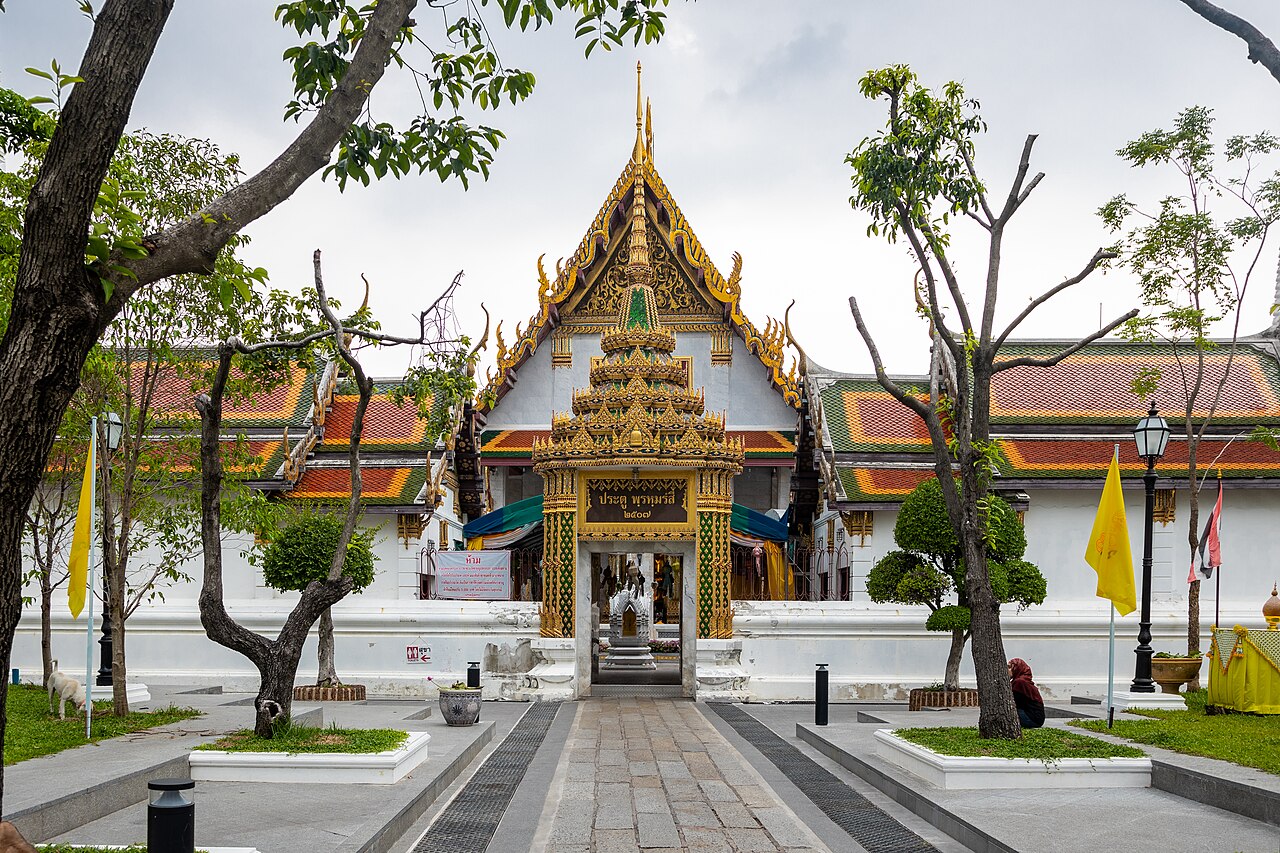
Stand at Tha Chang pier beside the Grand Palace and look across the Chao Phraya River. On the far bank, framed by rain trees and the rooftops of Siriraj Hospital, rises a slender corn-cob prang and a cluster of orange-tiled roofs. This is Wat Rakhang Khositaram Woramahawihan (วัดระฆังโฆสิตารามวรมหาวิหาร) — “the Temple of the Bell” — one of the oldest and most beloved monasteries in Bangkok, and, for anyone who cares about Thai amulets, quite simply hallowed ground. It was here that Somdej Phra Buddhacharn Toh Brahmaramsi served as abbot, and from here that the Phra Somdej Wat Rakhang, the most coveted amulet in Thailand, went out into the world.
But Wat Rakhang’s story begins long before Somdej Toh, and long before Bangkok itself.
From Wat Bang Wa Yai to Royal Monastery
The temple is older than the capital that surrounds it. It was founded in the Ayutthaya period — temple records cited by the ecclesiastical registers give a conventional founding date of around BE 2200 (c. 1657 CE) — under the name Wat Bang Wa Yai (วัดบางหว้าใหญ่), roughly “the great temple of the wa trees,” after the Java plum trees that once grew thickly along this stretch of the river. It had a smaller sibling, Wat Bang Wa Noi, which survives nearby today as Wat Amarintraram. Today it ranks as a second-class royal monastery of the woramahawihan grade, under the Mahanikaya order, standing in Siri Rat subdistrict of Bangkok Noi.
When Ayutthaya fell to the Burmese in 1767 (BE 2310), temples across Siam lost their patrons and fell into neglect. Wat Bang Wa Yai’s fortunes turned when King Taksin the Great established his new capital at Thonburi, almost on the temple’s doorstep. Taksin raised the humble community temple to the status of a royal monastery, and it became the residence of the Supreme Patriarch of his reign. It was also at this temple that Taksin convened the great council to revise and verify the Tripitaka — the Pali Buddhist canon — using manuscripts brought up from Nakhon Si Thammarat, with Somdet Phra Sangkharat (Si) presiding. For a brief, remarkable period, this riverside temple was effectively the administrative heart of Thai Buddhism.
The story of Sangkharat Si himself deserves telling. Originally a senior monk of Wat Phanan Choeng in Ayutthaya, he fled south to Nakhon Si Thammarat when the old capital burned. When Taksin took that city in 1769 (BE 2312), he invited the learned monk back with him and installed him at Wat Bang Wa Yai, soon elevating him to Supreme Patriarch. After the turmoil at the end of the Thonburi era, King Rama I restored him to the patriarchate in 1782 (BE 2325), making him the first Supreme Patriarch of the Rattanakosin era — Thai historians remember him as the “Supreme Patriarch of two kingdoms.” He presided here until his death in 1794 (BE 2337), and the line of abbots of Wat Rakhang begins with his name.
The King Who Lived Next Door
Wat Rakhang’s deepest royal connection, however, is with the founder of the present Chakri dynasty. Before he became King Rama I, the future monarch served King Taksin as a military officer under the title Phra Ratchawarin, and he lived in a wooden Thai house beside Wat Bang Wa Yai. When he was promoted, in keeping with the old custom of not clinging to worldly fortune, he donated his own residence to the temple, where it served as monks’ quarters.
After his accession in 1782, Rama I remembered the old house. He had his son, Prince Chim — the future King Rama II — convert it into a ho trai, a library for the Buddhist scriptures, set in a pond within the temple grounds. The roof was re-laid in tile, master painter Phra Acharn Nak was invited to paint the interior murals, and the doors and windows were finished in gilded lacquer. Tradition holds that the carved veranda doors were worked by Prince Chim’s own hand. Royal patronage continued through the king’s elder sister, Princess Thepsudawadi, mother of the Prince of the Rear Palace (Wang Lang) — which is why the neighbourhood around the temple is still called Wang Lang today. Her own residence stood beside the monastery, and she joined her brother in restoring it wholesale at the start of the new reign.
The Bell That Named a Temple
It was during this restoration, while the pond for the scripture library was being dug, that workmen unearthed a large ancient bell buried in the temple grounds. When struck, its voice proved so resonant and beautiful that word reached the king. Rama I asked for the bell to be installed at Wat Phra Si Rattana Satsadaram — the Temple of the Emerald Buddha — where it remains to this day. In exchange, he had five new bells cast and presented to the temple, together with a handsome four-porched (chaturamuk) bell tower to house them. The five bells still hang there, and have become the temple’s emblem — you will find a bell motif worked into the gilded lacquer of the ubosot’s doors and windows.
Because of this auspicious discovery, people began calling the monastery Wat Rakhang — the Temple of the Bell — and the name stuck with a stubbornness that even kings could not overcome. King Rama IV later decreed a more formal Pali name, Wat Rajkanthiyaram (“kanthi” also meaning bell), but the public simply ignored it and went on saying Wat Rakhang. The official name today, Wat Rakhang Khositaram, gracefully accepts the people’s verdict: khosit carries the sense of resounding, of a sound proclaimed far and wide.
That meaning matters to worshippers. Thais visit Wat Rakhang to pray for a good name — for a reputation that rings out clear and far, like the temple’s bells. Rows of bells hang in the courtyard, and visitors walk the line striking each one gently, sending a soft, overlapping peal across the temple grounds from morning to dusk. It is one of the most charming soundscapes in Bangkok.
The Ho Trai: A Masterpiece of Early Rattanakosin Art
The scripture library that began life as Rama I’s house still stands, and art historians regard it as one of the finest surviving works of early Rattanakosin architecture. It takes the form of three twinned traditional Thai houses joined under a shared veranda — by tradition a sleeping hall to the south, a central hall, and a reception hall to the north. The original thatched roof was replaced with tile, the eaves were lined with rows of carved thep phanom (praying deity) figures, and the walls were lined inside with teak boards to take the paintings. The southern doors are decorated in gilded black-lacquer lai rot nam; the east-facing doors of the central hall are carved with kanok scrollwork and the mythical wayuphak bird; and inside stand two great gilt-lacquered Tripitaka cabinets, one in each end hall. The murals attributed to Phra Acharn Nak, a painter of the first rank in the early Bangkok period, include scenes from the Ramakien, and the Fine Arts Department counts them among the most precious wall paintings of the era.
The building’s survival is its own story. By the mid-twentieth century the ho trai had decayed almost beyond rescue — at one point it was used as a kitchen, its murals blackened by cooking soot. The artist Fuea Haripitak campaigned for its preservation from 1957, devoting years of painstaking personal labour to cleaning and conserving the paintings, while architect Sumet Jumsai and a committee of conservationists secured royal and private funding. The restored library, relocated from its pond to a safer position in the temple grounds, was completed in time for Bangkok’s bicentennial celebrations in 1982. Anyone who visits today owes those conservators a debt of gratitude.
The Red House of King Taksin
The ho trai is not the only royal house sheltering within the monastery. In the residential quarter known as Khana 2 stands the Tamnak Daeng, the “Red House” — a red-painted wooden residence from the Thonburi era associated with King Taksin himself, relocated into the temple by the Wang Lang princely family after the king’s death. Prince Damrong Rajanubhab, the father of Thai history, visited the building and recorded the tradition that this was where King Taksin sat in meditation; the partition walls once bore dhamma-riddle paintings of a monk practising meditation beside a corpse, though these had already faded beyond recovery in his day. The house has since been restored, and an image of King Taksin is enshrined there for the many Thais who revere the liberator-king. Nearby stands a second, smaller scripture hall, a gilded green timber building with finely painted lacquer doors and windows.
The Buddha Who Smiles at the Sky
The temple’s ubosot (ordination hall) was rebuilt in the reign of Rama III, the new hall receiving its wisungkhamsima (formal consecration of the ordination boundary) in BE 2370 (1827 CE). Though built in the Third Reign, it follows the elegant First Reign style: a roof descending in three tiers, with chofa finials, bargeboard serpents, swan-tail ornaments and delicately carved brackets, and a pediment bearing Narayana mounted on Garuda amid gilded kanok flame patterns. The outer door and window panels carry gilded lacquer designs marked with the temple’s bell emblem; inside the panels, guardian deities stand on pedestals in full colour.
The murals within are counted among the finest of their period — painted around BE 2465 (1922 CE), when the hall was restored in the reign of King Rama VI, by Phra Wannawadwijit (Thong Charuwijit), a master painter of that reign. The wall facing the principal image shows the Buddha performing the Twin Miracle before ascending to spend the rains retreat in Tavatimsa heaven, and his descent from that heaven; behind the image, the monk Phra Malai pays homage to the Chulamani reliquary in Tavatimsa while the torments of hell unfold below; the upper registers all around show the assembly of celestial beings, and the lower walls the ten great Jataka lives of the Buddha.
The hall houses a bronze presiding Buddha in the meditation posture, its lap roughly four cubits wide, attended by figures of three disciples seated with hands raised in reverence as if receiving the Buddha’s teaching. The image bears one of the loveliest nicknames in Thailand: Phra Prathan Yim Rap Fa — “the presiding Buddha who smiles to receive the sky.” The name is credited to King Rama V, who, after presenting kathina robes at the temple — Wat Rakhang remains a temple honoured with the royal kathina to this day — remarked to his courtiers that no other temple greeted him like Wat Rakhang: the moment he entered the door of the ubosot, the principal image seemed to smile in welcome. So taken was the king that he conferred royal decorations — the Ancient and Auspicious Order of the Nine Gems and the Order of the White Elephant — upon the image itself, an honour almost never given to a Buddha statue.
The Model Prang and the Three Chedis
In front of the old vihara rises the temple’s riverside Phra Prang, built by King Rama I as a joint act of merit with his elder sister Princess Thepsudawadi. It is admired as the defining prang of the early Rattanakosin period: Prince Narisara Nuwattiwong — the great architect-prince revered as the father of modern Thai design — pronounced it the most correctly proportioned prang in Thailand, and its silhouette became the model (baep chabap) on which prangs of the later Bangkok era were patterned.
North of the ubosot stand three graceful chedis of the indented-corner, “cast-net” profile, modest in size but lovely in line. They were raised by the three princes of the Wang Lang line — Krommamuen Narathewet, Krommamuen Naret Yothi and Krommamuen Seni Borirak — as their contribution of merit when the new ordination hall was built in the Third Reign. Between the prang, the chedis, the bell tower, the two scripture halls and the Red House, the compound is a compact museum of early Bangkok architecture.
Somdej Toh and the Amulet Above All Amulets
For amulet collectors, everything at Wat Rakhang leads to one man. Somdej Phra Buddhacharn Toh Brahmaramsi — Somdej Toh — was appointed abbot here in 1852 (BE 2395) and remained until his passing on 22 June 1872 (BE 2415), receiving his exalted ecclesiastical title from King Rama IV in 1864. His biography deserves, and rewards, a full telling of its own; here it is enough to say that he was the most revered monk of nineteenth-century Siam, a preceptor to kings, and the author of the Chinnabanchorn katha that millions of Thais still chant.
In roughly the last six years of his life, around 1866 to 1872 (B.E. 2409–2415), Somdej Toh created the votive tablets we now call Phra Somdej Wat Rakhang. They were pressed from a sacred powder mixture — shell lime, his own consecrated phong wiset powders accumulated over decades of writing and erasing sacred scripts, flower pollen, traces of holy materials, bound with tung oil, and pressed in elegant moulds. Tradition credits the finest of these moulds to a royal goldsmith remembered as Luang Wichan Chiranai (also written Luang Vijarn Jayanurak), though no contemporary official record of such a person has been found, and some researchers regard the attribution as a later embellishment. The classic moulds number only a handful: Pim Yai (the large mould), Pim Song Chedi, Pim Ket Bua Tum and Pim Than Saem.
Several things set these amulets apart. Somdej Toh worked slowly and personally, producing modest numbers with great care, and he gave the tablets directly to devotees rather than sealing them in a chedi. Because they were never buried, surviving examples escaped the moisture damage that affects so many kru amulets — when his moulds were later borrowed to create the Phra Somdej of Wat Bang Khun Phrom in 1870, the buried tablets emerged from their chedi visibly the worse for the experience. Add the sanctity of the maker, the dignity of the design, and a supply measured in the low thousands against the devotion of an entire nation, and the result is inevitable.
The Phra Somdej Wat Rakhang heads the Benjapakee, the “five sublime amulets” of Thailand. Though it is the youngest of the five, it commands the highest prices of any amulet in existence — authenticated examples have changed hands for tens of millions of baht, and a fine Pim Yai is, for most collectors, a lifetime aspiration rather than a realistic purchase.
It is also, by an enormous margin, the most copied amulet ever made. Genuine examples are vanishingly rare; the temple itself, however, has issued later commemorative batches of Phra Somdej over the past century, and these remain a meaningful and affordable way to carry the Wat Rakhang lineage.
The Abbots Who Followed
The amulet tradition did not end with Somdej Toh, because the lineage of abbots that followed him kept it alive. From the Thonburi era to the present, twelve senior monks have governed Wat Rakhang. Somdej Toh was succeeded in 1872 by his own disciple, the prince-monk Mom Chao Phra Somdet Phra Buddhacharn (That Seniwong, BE 2415–2437) — himself a grandson of the Wang Lang house — who is traditionally credited with continuing the making of Somdej-style amulets. After him came Somdet Phra Phutthakosachan (Mom Ratchawong Charoen Itsarangkun, BE 2437–2470), one of the most senior prelates of his day.
Then, for more than four decades (BE 2470–2514, 1927–1971 CE), the temple was led by Phra Thep Sitthinayok — Luang Pu Nak Sophano — whose own powder amulets, blended with fragments and powders of broken original Phra Somdej tablets, are eagerly collected today as the most authentic continuation of the Somdej Toh recipe. The present abbot, Phra Thamma Thirarat Mahamuni (Thiang Akkhathammo), has led the monastery since 2007 (BE 2550).
The Commemorative Batches of BE 2515 and BE 2537
Two later batches matter most to collectors. For the 100th anniversary of Somdej Toh’s passing, the temple created the famous Phra Somdej “Anusorn 100 Pi” of BE 2515 (1972 CE): powder amulets pressed by hand, one by one, in the old manner — the only modern Wat Rakhang batch made that way — together with bronze images, loket-style portrait images and medals of Somdej Toh. They were consecrated in three great ceremonies, on 16 and 18 September 1971 and finally on 22 June 1972, the centenary day itself. Half a century on, the 100 Pi series has become a classic in its own right, prized for metta and protective blessings and increasingly expensive.
For the 122nd anniversary, the temple issued the Phra Somdej “Anusorn 122 Pi” of BE 2537 (1994 CE), produced in five mould designs and consecrated in the ubosot on 22 June 1994 with 112 famous master monks from across Thailand seated in meditation around the tablets. Both batches still come within reach of ordinary devotees, and both carry the unbroken blessing-lineage of the Temple of the Bell.
Visiting Wat Rakhang
The temple stands at 250/1 Arun Amarin Road in Bangkok Noi district, on the Thonburi (west) bank of the Chao Phraya, between Siriraj Hospital and Wat Arun. The most pleasant approach is the one pilgrims have used for two centuries: the cross-river ferry from Tha Chang pier beside the Grand Palace, a crossing of a few minutes that lands you at the temple’s own pier. The Wang Lang pier and its famously good street-food market are a short walk away. The grounds are open daily, generally from 8.00 a.m. to 5.00 p.m., and admission is free; dress modestly, as at any royal monastery.
Within the grounds, pay your respects to the smiling presiding Buddha in the ubosot, visit the ho trai and its murals, see the Red House and the model prang, and ring the rows of bells. At the riverside pavilion, join the locals releasing fish into the Chao Phraya as an act of merit — the temple’s waterfront is one of Bangkok’s favourite spots for this gentle tradition, and the river boils with catfish waiting to be fed. The shrine and statue of Somdej Toh draw a constant stream of devotees, many of whom chant the Chinnabanchorn katha before his image. Wat Rakhang is included in Bangkok’s traditional “nine temples” merit-making circuit promoted by the Tourism Authority of Thailand, alongside Wat Phra Kaew, Wat Pho, Wat Suthat, Wat Chana Songkhram, the City Pillar Shrine and San Chao Pho Suea on the Phra Nakhon side and Wat Arun and Wat Kalayanamit on the Thonburi side. The blessing sought here is fitting for the Temple of the Bell: may your good name resound far and wide.
Few places gather so many threads of Thai Buddhist history in one riverside compound — an Ayutthaya foundation, Taksin’s Tripitaka council and his meditation house, the patriarchate of two kingdoms, the house of the first Chakri king, a masterpiece scripture library, a model prang, and the cell of the monk whose little powder tablets became the most treasured objects in the amulet world. Wat Rakhang earns its name twice over: in bronze, and in renown.
Frequently Asked Questions
Why is Wat Rakhang called the Temple of the Bell?
During King Rama I’s restoration, workmen digging a pond for the scripture library unearthed an ancient bell with a remarkably beautiful tone. The king moved it to the Temple of the Emerald Buddha and presented five new bells in exchange, and people began calling the monastery Wat Rakhang — the Temple of the Bell.
Who was Somdej Toh of Wat Rakhang?
Somdej Phra Buddhacharn Toh Brahmaramsi was appointed abbot of Wat Rakhang in 1852 and served until his passing on 22 June 1872. The most revered monk of nineteenth-century Siam and a preceptor to kings, he created the Phra Somdej Wat Rakhang amulets and authored the Chinnabanchorn katha that millions still chant.
Why are Phra Somdej Wat Rakhang amulets so valuable?
Somdej Toh pressed them slowly and personally between about 1866 and 1872, in numbers measured in the low thousands, and gave them directly to devotees rather than burying them. Heading the Benjapakee set of five sublime amulets, authenticated examples have changed hands for tens of millions of baht.
How do I get to Wat Rakhang?
The temple stands at 250/1 Arun Amarin Road in Bangkok Noi, on the Thonburi bank of the Chao Phraya between Siriraj Hospital and Wat Arun. The easiest approach is the short cross-river ferry from Tha Chang pier beside the Grand Palace. Grounds are open daily, roughly 8.00 a.m. to 5.00 p.m., with free admission.
What do people pray for at Wat Rakhang?
Because the temple’s name evokes a sound that resounds far and wide, Thais visit to pray for a good name and reputation. Visitors ring the rows of bells in the courtyard, release fish into the Chao Phraya as an act of merit, and chant the Chinnabanchorn katha before the statue of Somdej Toh.
Sources
- วัดระฆังโฆสิตารามวรมหาวิหาร — Thai Wikipedia
- Wat Rakhangkhositaram — Wikipedia (English)
- เบื้องหลังการฟื้นฟู บ้านพระราชวรินทร์ สู่หอไตร ในวัดระฆัง — Silpa-Mag (ศิลปวัฒนธรรม)
- “วัดระฆังโฆสิตารามวรมหาวิหาร” เคยมีชื่อว่า “คัณฑิยาราม” — Silpa-Mag
- “พระสมเด็จวัดระฆังฯ” พระที่สมเด็จพระพุฒาจารย์ (โต พรหมรังสี) สร้าง — Silpa-Mag
- พระประธานยิ้มรับฟ้า วัดระฆัง — Silpa-Mag
- สมเด็จพระสังฆราช (ศรี) สมเด็จพระสังฆราช 2 แผ่นดิน — Silpa-Mag
- จิตรกรรมฝาผนังในหอไตร วัดระฆังโฆสิตาราม วรมหาวิหาร — Fine Arts Department (กรมศิลปากร)
- ชวนสำรวจ “ระฆัง” กับ “หอไตร” ที่วัดระฆัง — Matichon Weekly
- วัดระฆังโฆสิตาราม วรมหาวิหาร — DhammaThai
- องค์ที่ ๑ สมเด็จพระสังฆราช (ศรี) วัดระฆังโฆสิตาราม — DhammaThai
- ประวัติ วัดระฆังโฆสิตารามวรมหาวิหาร เขตบางกอกน้อย — Kachon
- พระตำหนักแดง วัดระฆังโฆสิตาราม — Komchadluek
- พระสมเด็จอนุสรณ์ครบ 100 ปี วัดระฆังโฆสิตาราม — สมาคมส่องพระแท้เมืองสยาม
- วัดระฆังโฆสิตาราม วรมหาวิหาร กรุงเทพ ไหว้พระวัดดังริมเจ้าพระยา — Kapook Travel
- Thai Buddha amulet — Wikipedia