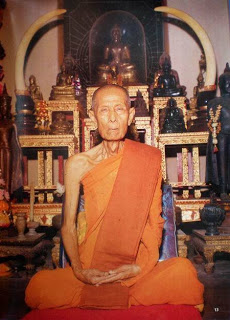
Few modern Thai monks command the reverence still given to Phra Rajasangwarabhimon (พระราชสังวราภิมณฑ์), known affectionately across Thailand as Luang Pu Toh (หลวงปู่โต๊ะ) of Wat Pradoo Chimplee (วัดประดู่ฉิมพลี) in Thonburi, Bangkok. More than four decades after his passing, his amulets — above all his Phra Pidta (พระปิดตา) — remain among the most sought-after sacred objects in the Thai collecting world.
Introduction to Luang Pu Toh: The Ascetic Master of Bangkok
Luang Pu Toh was born on 27 March 1887 (พ.ศ. 2430) in Samut Songkhram province, the son of Nai Ploy and Nang Thap. Orphaned of his mother as a boy, he was brought to Wat Pradoo Chimplee, where he studied before ordaining as a novice at seventeen. He took full ordination on 16 July 1907 (พ.ศ. 2450) in the ordination hall of Wat Pradoo Chimplee, receiving the Pali monastic name Inthasuwanno (อินฺทสุวณฺโณ). In 1913 (พ.ศ. 2456) he became abbot of the temple — a position he would hold for roughly 68 years until his death on 5 March 1981 (พ.ศ. 2524).
Thai accounts consistently describe him as gentle, humble, and unfailingly compassionate, devoting himself to meditation and to the welfare of all who came to him. His standing was formally recognised through a series of royally-conferred ecclesiastical titles recorded in the Royal Gazette (ราชกิจจานุเบกษา), culminating in the rank of Phra Rajasangwarabhimon in 1978 (พ.ศ. 2521).
The Royal Connection: Devotion of Kings and Princes
The most distinctive thread in Luang Pu Toh’s biography is his relationship with the Thai monarchy. Thai sources record that King Bhumibol Adulyadej (Rama IX), Queen Sirikit, and members of the royal family held deep personal faith in him and made private visits to Wat Pradoo Chimplee to pay their respects and seek his blessings. Upon his death, the King granted special royal funeral honours — including a royal urn and regalia befitting a senior ecclesiastic — a mark of the esteem in which he was held at the highest level of Thai society.
It is worth stating plainly what the sources do and do not establish: they document genuine royal devotion and royally-granted funeral honours, both well attested in Thai reporting. Readers will sometimes see grander claims of a formal royal office; those should be treated with caution unless supported by a primary record.
The Spiritual Lineage and Monastic Virtues of Wat Pradoo Chimplee
Luang Pu Toh’s reputation rested first on his practice, not on his amulets. He was known for strict discipline, sustained meditation, and an ascetic disposition associated in Thai tradition with Dhutanga (ธุดงค์) — the austere practices of the wandering forest monk. His decades as abbot turned Wat Pradoo Chimplee into a centre of devotion, and it was this spiritual authority that gave his consecrated objects their standing. In Thai belief, the power of an amulet flows from the virtue and meditative attainment of the monk who blesses it; Luang Pu Toh’s pluk sek (ปลุกเสก, empowerment) is precisely why his pieces are so trusted.
The Legend of Phra Pidta: Sensory Withdrawal and Ultimate Protection
The Phra Pidta (พระปิดตา), literally the “closed-eye” or “covered-face” Buddha, depicts a figure raising its hands to cover the face. In Thai understanding this gesture symbolises the closing of the nine bodily orifices (ทวารทั้ง ๙) — the gates of the senses — and the turning of the mind inward in meditation. It is an image of withdrawal from the distractions of the world and of self-contained spiritual protection.
Luang Pu Toh’s Phra Pidta are especially prized for metta mahaniyom (เมตตามหานิยม) — loving-kindness and personal charisma — as well as for success in trade and for what Thai devotees call plod nee (ปลดหนี้), “debt relief.” The pieces are made from sacred pastes such as burnt palm-leaf-manuscript ash (เนื้อผงใบลาน), flower pollen (เนื้อผงเกสร), and Somdej-type powder (เนื้อผงสมเด็จ), often with a rolled metal takrut (ตะกรุด) inserted into the body.
Analysis: Reading the Pidta — Mould Families and Collector Debate
Among collectors, judging a Luang Pu Toh Pidta means reading fine physical detail: the depth of the groove between the hands, the definition of the fingers, the bulk of the arms, the texture of the powder, and the yantra on the reverse. Enthusiasts discuss subtle variations in how the fingers and arms are folded, and you will hear shorthand terms traded in the marketplace for these differences. Those finger-and-arm “fold” labels are part of living collector conversation rather than formal temple typology, so they are best treated as points of discussion to confirm with a trusted expert — not as fixed categories.
What is well documented in Thai sources are the distinct mould families and batches the temple produced. The table below sets the most-cited batches side by side. Figures reflect collector-consensus records; they are descriptive, not a statement of market value or authenticity.
| Batch / Mould | Year | Materials & Reported Mintage | Distinguishing Features |
|---|---|---|---|
| Jumbo 1 (จัมโบ้ ๑) | 1977 (พ.ศ. 2520) | Palm-leaf ash 1,272; pollen 57; Somdej powder 16 | Made for his 90th-year celebration; notably larger than other moulds; the most celebrated batch. |
| Tukkata Yai (ตุ๊กตาใหญ่) | 1978 (พ.ศ. 2521) | Palm-leaf ash, grey tone; ~6,000 pieces; with or without silver takrut | Freestanding “floating” image that stands upright; first Pidta the temple itself produced. |
| Tukkata Lek (ตุ๊กตาเล็ก) | 1978 (พ.ศ. 2521) | Flower-pollen paste; 1,014 with takrut, 3,108 without | Stands upright; deep groove between the hands, well-defined fingers and bulky arms; Yant Na (ยันต์นะ) on the reverse. |
| Yant Duang Lek (ยันต์ดวงเล็ก) | 1978–1980 (พ.ศ. 2521–2523) | Sacred powder, small format | Reduced size; the “Sukitti Ma” circular yantra (ยันต์สุกิตติมา) on the back; highly popular for its wearable scale. |
Because these distinctions matter so much to value and authenticity, serious buyers cross-check any piece against established references and reputable certification before acquiring it.
Conclusion: The Living Legacy of Luang Pu Toh in Modern Thailand
Luang Pu Toh’s legacy endures on two levels. As a monk, he is remembered for a lifetime of discipline, meditation, and compassion that earned the devotion of ordinary Thais and royalty alike. As a maker of sacred objects, he left behind Phra Pidta whose reputation for loving-kindness, prosperity, and protection has only grown since his death in 1981. For collectors and devotees, owning one of his amulets is as much a connection to that spiritual life as it is to a celebrated chapter of Thai Buddhist history.
Frequently Asked Questions
Q: Who was Luang Pu Toh of Wat Pradoo Chimplee?
He was Phra Rajasangwarabhimon (Toh Inthasuwanno, หลวงปู่โต๊ะ), a revered Bangkok monk (1887–1981) who served as abbot of Wat Pradoo Chimplee in Thonburi for around 68 years.
Q: Why is Luang Pu Toh connected to the Thai Royal Family?
Thai sources record that King Bhumibol Adulyadej (Rama IX), Queen Sirikit and the royal family held personal faith in him, visited Wat Pradoo Chimplee privately, and that special royal funeral honours were granted at his death.
Q: What is a Phra Pidta amulet?
A Phra Pidta (พระปิดตา) is a “closed-eye” Buddha whose raised hands cover the face to symbolise closing the nine bodily orifices and withdrawing the senses in meditation.
Q: What is Luang Pu Toh’s Phra Pidta famous for?
It is prized in Thai collecting for loving-kindness and charisma (metta mahaniyom), success in trade, and “debt relief” (ปลดหนี้).
Q: Which Luang Pu Toh Phra Pidta batch is the most sought-after?
Thai collector sources point to the “Jumbo 1” batch (จัมโบ้ ๑, 1977), made for his 90th-year celebration, as the most celebrated and valuable.
Q: When did Luang Pu Toh pass away?
He passed away on 5 March 1981 (พ.ศ. 2524) at Wat Pradoo Chimplee.
Featured image: Wat Pradu Chimphli — photo by กสิณธร ราชโอรส, CC BY-SA 4.0, via Wikimedia Commons.
_วัดประดู่ฉิมพลี_เขตบางกอกใหญ่_กรุงเทพมหานคร_(1).jpg)