
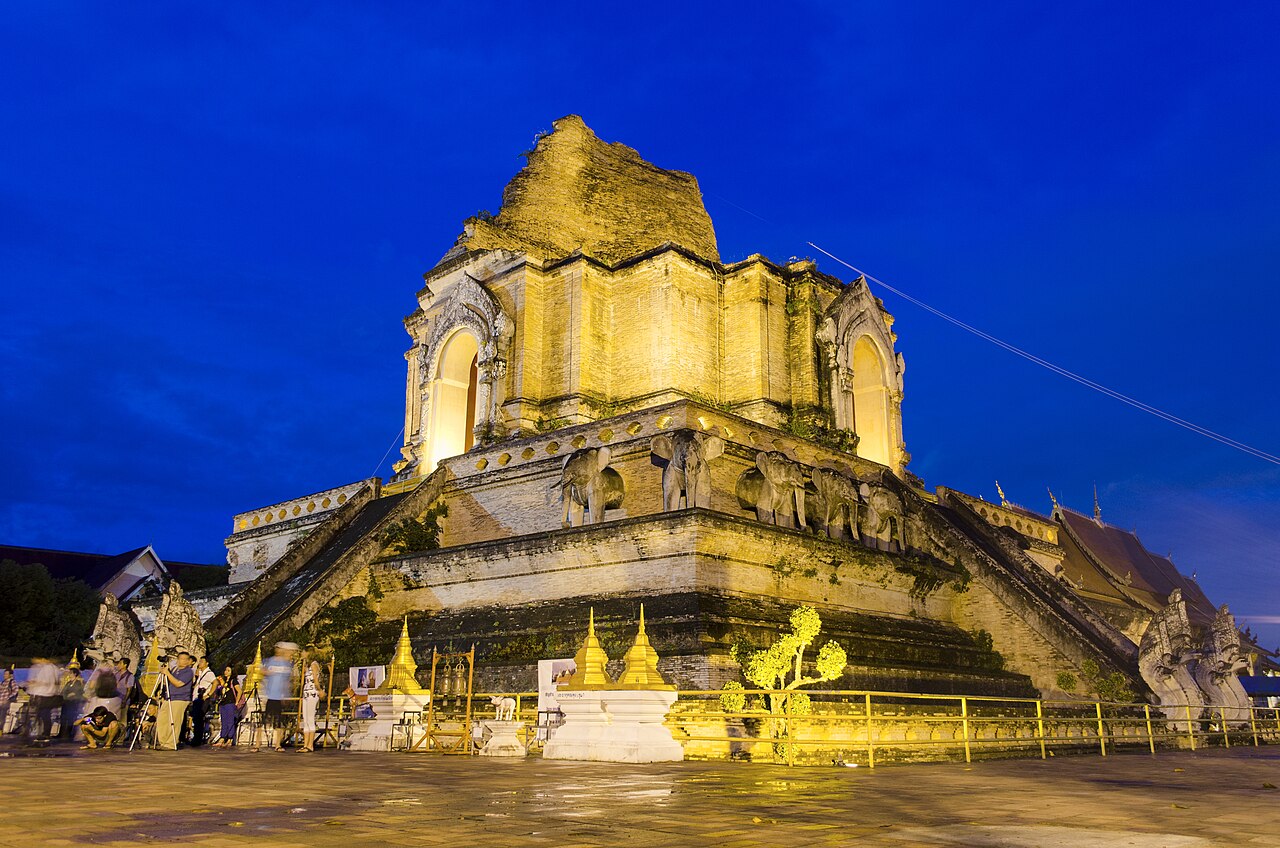
In the serene heart of Chiang Mai, nestled within the ancient city walls, stands a testament to enduring faith and architectural grandeur: Wat Chedi Luang. This venerable temple complex, dominated by its partially ruined yet awe-inspiring Grand Stupa, serves not merely as a historical landmark but as a living repository of Lanna Buddhist culture and profound spiritual teachings. It invites contemplation, offering a journey through centuries of devotion, resilience, and the timeless principles of Dhamma.
A Legacy Etched in Stone: The Genesis and Zenith
The origins of Wat Chedi Luang trace back to the late 14th century, initiated by King Saen Muang Ma of the Lanna Kingdom to inter the ashes of his father. However, it was during the reign of King Tilokkarat (1441-1487) that the colossal stupa reached its intended magnificent height, reportedly soaring over 80 meters with a base diameter of 44 meters. For generations, it stood as the tallest structure in Chiang Mai and, indeed, the entire Lanna realm, a dazzling symbol of the kingdom’s prosperity and unwavering devotion to Buddhism.
Its spiritual pinnacle was reached when it housed the revered Emerald Buddha (Phra Kaeo Morakot) for over 80 years, from 1468 to 1551. This sacred relic, now enshrined at Wat Phra Kaeo in Bangkok, brought immense prestige and sanctity to Wat Chedi Luang, solidifying its status as the spiritual epicenter of the Lanna world.
The Dance of Impermanence: Decline and Resilience
The majestic stupa’s glory was dramatically altered by the devastating earthquake of 1545. This natural cataclysm severely damaged the upper sections of the chedi, reducing its height and leaving it in a partially ruined state. Subsequently, as Chiang Mai fell under Burmese rule, and later, the stupa was not fully restored to its original height, symbolizing the very Buddhist teaching of anicca (impermanence).
Despite its fragmented form, the stupa’s spiritual essence endured. Efforts in the 1990s, funded by UNESCO and the Japanese government, aimed at conservation rather than complete reconstruction, meticulously restoring the lower sections and the iconic elephant sculptures, preserving its historical integrity and the poignant beauty of its weathered grandeur.
Architectural Splendor and Symbolic Guardians
The architecture of Wat Chedi Luang is a quintessential example of Lanna craftsmanship, blending practicality with deep spiritual symbolism:
- The Grand Stupa: The colossal chedi, though incomplete, remains profoundly impressive. Its sheer scale evokes a sense of awe and connection to the past. The intricate brickwork and the surviving architectural elements speak volumes of ancient skill.
- Naga Staircases: Each of the four cardinal directions originally featured a grand staircase flanked by magnificent naga (mythical serpent) balustrades, leading to a niche that once housed a Buddha image. The naga symbolize protection and the journey towards enlightenment.
- Elephant Sculptures (Gajasingha): At the stupa’s base, particularly on the eastern side, beautifully restored life-sized elephant sculptures (gajasingha) emerge from the brickwork. These powerful creatures act as guardians of the Dhamma, representing strength, wisdom, and protection.
- Phra Phutthakhodom (Replica Emerald Buddha): Today, a jade replica of the Emerald Buddha, known as Phra Phutthakhodom, stands enshrined on the eastern side of the stupa, offering a focal point for veneration and reflecting its past glory.
- Viharns and Mondop: The complex includes several beautiful viharns (assembly halls), notably the large Wihan Luang with its impressive standing Buddha image, Phra Chao Attarot. These spaces are adorned with intricate murals, golden motifs, and house various Buddha images, providing tranquil settings for prayer and meditation.
The Sacred Grounds: Beyond the Stupa
Within the extensive grounds of Wat Chedi Luang, other significant elements contribute to its spiritual landscape:
- Lak Mueang (City Pillar): Adjacent to the main stupa, within its own serene enclosure, lies the Lak Mueang, or City Pillar of Chiang Mai. Believed to house the guardian spirit of the city, its presence underscores the temple’s role not just as a religious center but as the spiritual heart of the entire Lanna capital. A venerable Dipterocarp tree (locally known as Yang Na tree) stands nearby, believed to protect the city from harm, embodying a fusion of animist beliefs with Theravada Buddhism.
- Monastic Quarters: The temple continues to be an active monastery, housing a community of monks (the Sangha). This provides a living connection to the Buddhist tradition, offering opportunities for interaction and learning for those genuinely interested in the monastic way of life.
- Buddhist University: Wat Chedi Luang is also home to a campus of the Mahamakut Buddhist University, furthering its role as a center for Buddhist education and scholarship.
A Place of Reflection and Dhamma Practice
Visiting Wat Chedi Luang is more than just sightseeing; it is an invitation to engage with centuries of Buddhist devotion. The tranquil atmosphere encourages mindfulness and contemplation. Pilgrims and visitors come to make merit (tamboon), offer prayers, light incense, and reflect on the profound teachings of the Buddha. The very ruin of the stupa serves as a potent visual sermon on the themes of impermanence (anicca), suffering (dukkha), and non-self (anatta) – core tenets of Buddhist philosophy.
Cultural Respect and Reverence
As a sacred site, visitors are encouraged to observe proper etiquette:
- Dress Modestly: Shoulders and knees should be covered as a sign of respect.
- Remove Shoes: Before entering any viharn or sacred building.
- Maintain Silence: Speak softly and act with reverence, especially around areas of worship or meditation.
- Respect Monks: Women should avoid direct physical contact with monks.
Conclusion: The Enduring Spirit of Lanna
Wat Chedi Luang stands as a magnificent emblem of Chiang Mai’s spiritual and historical identity. Its weathered stones tell tales of kings and earthquakes, of great artistic achievements and the ever-present cycle of change. It reminds us of the profound depth of Lanna culture and the enduring power of Buddhist teachings. For those who seek a deeper understanding of Thailand’s spiritual heritage, a moment spent in quiet contemplation before the Grand Stupa of Wat Chedi Luang is a truly enriching and unforgettable experience, a connection to the very heart of the Dhamma.
Frequently Asked Questions (FAQ) & Key Concepts
Q: What is Wat Chedi Luang’s primary significance?
Wat Chedi Luang is primarily significant as Chiang Mai’s ancient spiritual heart, a testament to the grandeur of the Lanna Kingdom, and a profound symbol of Buddhist resilience and impermanence.
Q: What does “Chedi Luang” mean?
“Chedi Luang” translates to “Grand Stupa” or “Royal Stupa” in Thai, reflecting its original colossal size and spiritual importance within the Lanna Kingdom.
Q: What sacred relic did Wat Chedi Luang once house?
Wat Chedi Luang famously housed the revered Emerald Buddha (Phra Kaeo Morakot) for over 80 years, greatly enhancing its prestige before the Buddha image was moved to Luang Prabang and eventually to Bangkok.
Q: What caused the damage to the main stupa?
The upper sections of the main stupa were severely damaged by a powerful earthquake in 1545, reducing its height and leaving it in its current majestic, partially ruined state.
Q: What is the significance of the elephant sculptures at the stupa’s base?
The elephant sculptures (gajasingha) at the base of the stupa symbolize strength, wisdom, and protection, serving as guardians of the Dhamma and sacred space.
Q: What is the Lak Mueang (City Pillar) within the complex?
The Lak Mueang is Chiang Mai’s City Pillar, believed to house the guardian spirit of the city, representing its spiritual foundation and offering protection, often associated with an ancient Dipterocarp tree.
Q: Can visitors meditate or engage in spiritual practice at Wat Chedi Luang?
Yes, visitors are welcome to engage in quiet contemplation, meditation, and merit-making, respectfully observing the temple’s serene atmosphere and sacred nature.