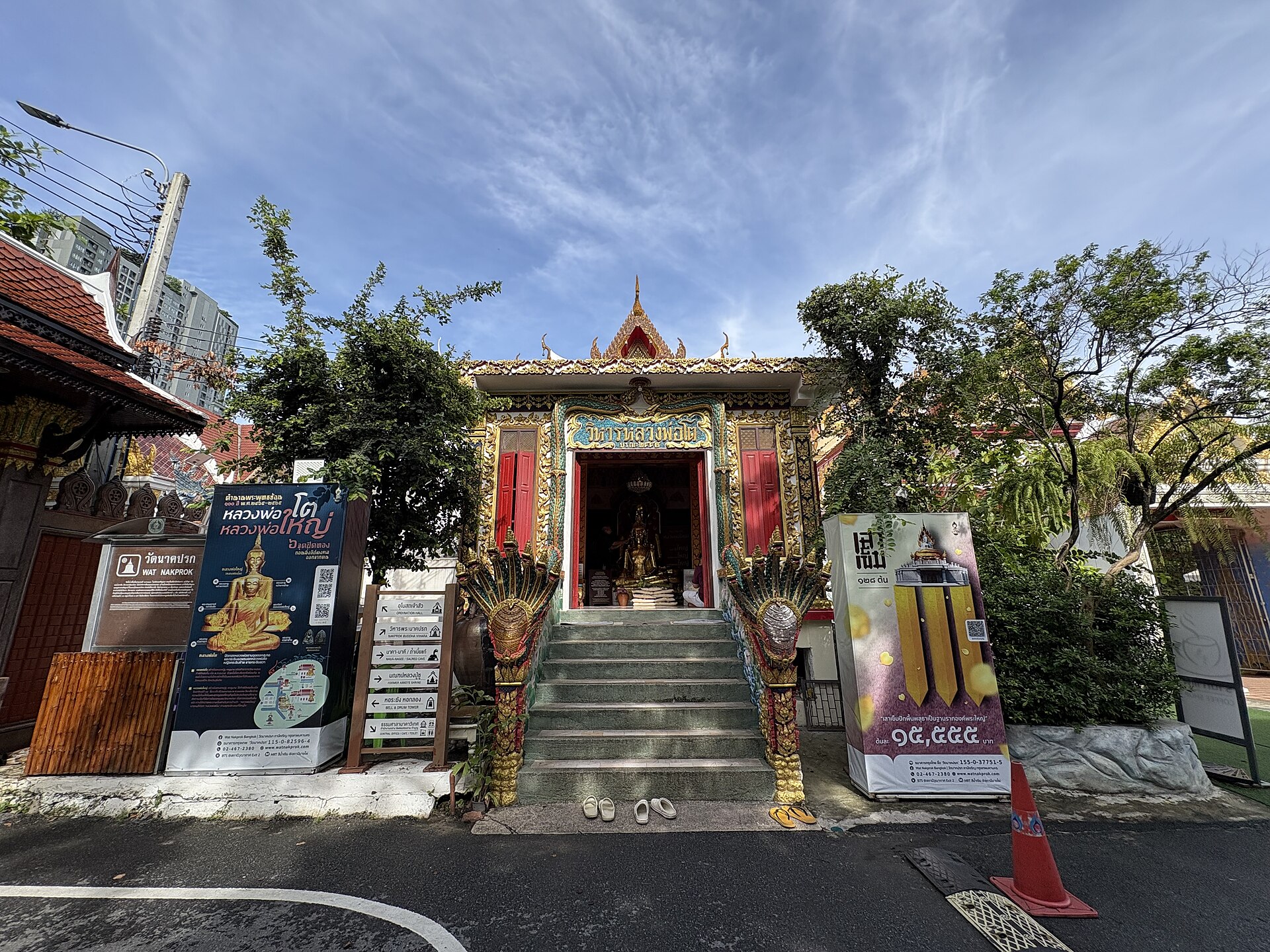
Wat Nak Prok (วัดนาคปรก) is a nearly 300-year-old royal-charter community temple in the Phasi Charoen district of Thonburi, Bangkok, best known for Luang Pho Nak Prok, a sacred Buddha image seated beneath the spreading hood of a seven-headed serpent king. Belonging to the Maha Nikaya order of Theravada Buddhism, the temple dates to the late Ayutthaya period and today draws devotees who come to honour the Naga, pass beneath the ordination hall for good fortune, and pay respect to Buddha images more than seven centuries old.
Quietly tucked along Thoet Thai Road near BTS Wutthakat, Wat Nak Prok sits in the same historic neighbourhood as the famous Wat Paknam Bhasicharoen. While less internationally known than its neighbour, it has become a favourite among Thai devotees of the Phaya Nak (Naga) and those born on a Saturday, for whom the Naga-sheltered Buddha is the protective image of their birthday.
The History of Wat Nak Prok
Wat Nak Prok is an old community temple believed to have been founded in the late Ayutthaya period, during the reign of King Borommakot (Somdet Phra Chao Yu Hua Borommakot), around B.E. 2291 (1748 CE). According to temple tradition, it was built through the collective effort of villagers in the surrounding orchard community rather than by a single royal founder. The area was then thick with fruit gardens and forest, and locals originally called the temple “Wat Pok,” meaning the temple “covered over” by the canopy of trees — a name that later evolved into Nak Prok.
Like many temples of the lower Chao Phraya basin, Wat Nak Prok suffered during the wars that ended the Ayutthaya kingdom. With villagers fleeing the fighting, the temple fell into a period of abandonment before being restored and re-established as the Bangkok era took shape across the river in Thonburi and Rattanakosin.
The temple is classified as a wat rat (a people’s, or non-royal, temple) under the Maha Nikaya fraternity. On 13 December B.E. 2520 (1977 CE), Thailand’s Fine Arts Department (กรมศิลปากร), the agency of the Ministry of Culture responsible for the nation’s heritage, formally registered Wat Nak Prok as a national ancient monument, recognising the historical value of its ordination hall, sanctuary, and venerable Buddha images.
A Temple Tied to Chinese Merchant Patronage
Wat Nak Prok’s revival owes much to wealthy Chinese-Thai merchants who settled around nearby Talat Phlu, a long-established trading quarter of old Thonburi. Patrons bearing the noble merchant rank of Phraya Chotuek Rajasetthi are credited in temple accounts with major works of restoration and adornment. This mercantile connection survives in the popular name of the temple’s secondary Buddha images, the “Luang Pho Jao Sua,” literally “the Reverend Father of the Wealthy Merchant,” a title that continues to attract those who pray for prosperity in trade and business.
Luang Pho Nak Prok: The Naga-Sheltered Buddha
The heart of the temple, and the source of its name, is Luang Pho Nak Prok, the principal Buddha image enshrined in the vihara (sanctuary). The image depicts the Buddha seated in meditation beneath a great serpent that rises behind and above him, its body coiled into four tiers and its seven heads fanned out in a protective hood. The Naga figure was modelled in stucco over a structural core of takian hardwood and finished with coloured plaster inlaid with shimmering glass mosaic, a decorative technique typical of Thai temple craftsmanship.
This iconography is known as the Naga Prok attitude. It recalls the episode in the Buddha’s life when, in the weeks after his enlightenment, a powerful Naga king named Mucalinda rose from the earth to shield the meditating Buddha from a violent, days-long storm, coiling his body as a seat and spreading his hood as an umbrella. Because of this story, the Naga-sheltered Buddha became associated in Thai tradition with people born on a Saturday, for whom it serves as the phra prajam wan koet, the Buddha image of their day of birth.
To devotees, the seven-headed Naga arching over the serene Buddha is a vivid reminder that even the most fearsome forces of nature bow in protection before awakened compassion.
The Sukhothai Buddhas of the Ordination Hall
Beyond the famous Naga image, Wat Nak Prok safeguards two bronze Buddha images in the Maravijaya (subduing Mara) posture that are enshrined as the principal images of the ubosot (ordination hall). Temple tradition holds that these graceful figures date from the Sukhothai period and are more than 700 years old, brought to the temple by its merchant patrons. Known affectionately as Luang Pho Jao Sua, they are among the most treasured antiquities the temple preserves, and their Sukhothai-era styling links Wat Nak Prok to one of the great flowerings of Thai Buddhist art.
Sacred Practices and Devotional Life
Wat Nak Prok has gained a strong following among Thailand’s sai mu community — devotees who actively seek blessings and auspicious merit. Worship at the temple typically follows a sequence: paying homage to Luang Pho Nak Prok inside the sanctuary, honouring respected past abbots and revered monks such as Luang Pu Chu Khongchunam, and then performing the well-known rite of passing beneath the ordination hall.
This ritual, called lot bot (“passing under the ubosot”), involves walking three times through the space beneath the raised ordination hall while reciting a prayer provided at the site. Devotees believe the practice helps lift a run of bad luck, renew a fading horoscope, and draw in wealth and prosperity. For visitors born on a Saturday, a visit to honour their birthday Buddha here carries special meaning.
The temple is also widely associated with veneration of the Phaya Nak, the serpent deities of Thai and wider Southeast Asian belief who are regarded as guardians of water, fertility, and hidden treasure. This deep Naga connection is what most distinguishes Wat Nak Prok within Bangkok’s landscape of temples, and it is why the temple resonates so strongly with collectors drawn to Naga-themed sacred objects. You can explore more sacred sites in our temples section.
Wat Nak Prok and Thai Amulets
For amulet devotees, Wat Nak Prok is significant precisely because of its identity as a centre of Naga worship. Sacred objects associated with the temple and its Naga theme — including Naga-tooth (Phaya Nak fang) talismans, images of the elephant-headed deity Phra Phikanet (Ganesha) for success and wisdom, and revered monk amulets such as those of Luang Pu Thuat — are sought by collectors who wish to carry the temple’s blessings of protection and prosperity with them.
In Thai belief, an amulet’s potency rests on the sacredness of the place it comes from, the virtue of the monks who consecrate it, and the proper performance of the phutthaphisek blessing ceremony. A temple as old as Wat Nak Prok, steeped in Naga symbolism and registered as a national monument, lends exactly the kind of provenance and meaning that devotees value. Browse authentic pieces in our amulets collection or visit the shop to see current items, and learn the traditional chants used when wearing them.
Visiting Wat Nak Prok
Wat Nak Prok stands at 342 Soi Thoet Thai 49, Pak Khlong Phasi Charoen, in Bangkok’s Phasi Charoen district. The temple is most easily reached via the BTS Silom Line to Wutthakat station, from where it is a short ride, and it can be comfortably combined in a single outing with a visit to the towering white pagoda of nearby Wat Paknam Bhasicharoen. As at any active place of worship, visitors should dress modestly with shoulders and knees covered, remove their shoes before entering the halls, and behave quietly and respectfully around those at prayer.
Frequently Asked Questions
What is Wat Nak Prok?
Wat Nak Prok is a late-Ayutthaya-period Buddhist temple in the Phasi Charoen district of Bangkok, founded around B.E. 2291 (1748 CE). It is famous for Luang Pho Nak Prok, a Buddha image seated beneath a seven-headed Naga, and was registered as a national ancient monument by the Fine Arts Department on 13 December B.E. 2520 (1977 CE).
Why is the temple called Nak Prok?
The name comes from its principal image, Luang Pho Nak Prok, a Buddha sheltered by a great seven-headed serpent (Naga). “Nak” means Naga and “prok” means to cover or shelter. Locals had earlier called it “Wat Pok,” referring to the dense orchard canopy that once covered the grounds, a name that evolved over time.
Who should worship at Wat Nak Prok?
The temple is especially meaningful for people born on a Saturday, since the Naga-sheltered Buddha is their birthday image. It also draws devotees of the Phaya Nak and anyone seeking protection, good fortune, or relief from a difficult period through the rite of passing three times beneath the ordination hall.
What is the lot bot ritual?
Lot bot means “passing under the ubosot.” Devotees walk three times through the space beneath the raised ordination hall while reciting a prayer offered at the site. The practice is believed to dispel bad luck, refresh a fading horoscope, and invite wealth, making it one of the most popular activities at Wat Nak Prok.
How do I get to Wat Nak Prok?
The temple is located on Thoet Thai Road in Pak Khlong Phasi Charoen, Bangkok. The most convenient route is the BTS Silom Line to Wutthakat station, followed by a short taxi or motorbike ride. Many visitors pair the trip with the nearby Wat Paknam Bhasicharoen and its giant Buddha and pagoda.
Sources
- เรื่องราววัด (Temple History) — Wat Nak Prok official website
- พระพุทธรูปนาคปรก (Naga Prok Buddha image) — Fine Arts Department, Ministry of Culture (กรมศิลปากร)
- วัดนาคปรก — Dhammathai Thai Temple Directory (ทำเนียบวัดไทย)
- พระพุทธรูปนาคปรก (Naga Prok iconography) — Princess Maha Chakri Sirindhorn Anthropology Centre (SAC)
- วัดนาคปรก ลอดโบสถ์เสริมดวง ไหว้หลวงพ่อเจ้าสัว หลวงพ่อนาคปรก — Kapook Travel (devotional practices)
- เสริมสิริมงคล “วัดนาคปรก” — MGR Online / Manager (visitor guide)
Featured image: Wat Nak Prok — via Wikimedia Commons, CC BY 4.0.
_-_img_03.jpg)