
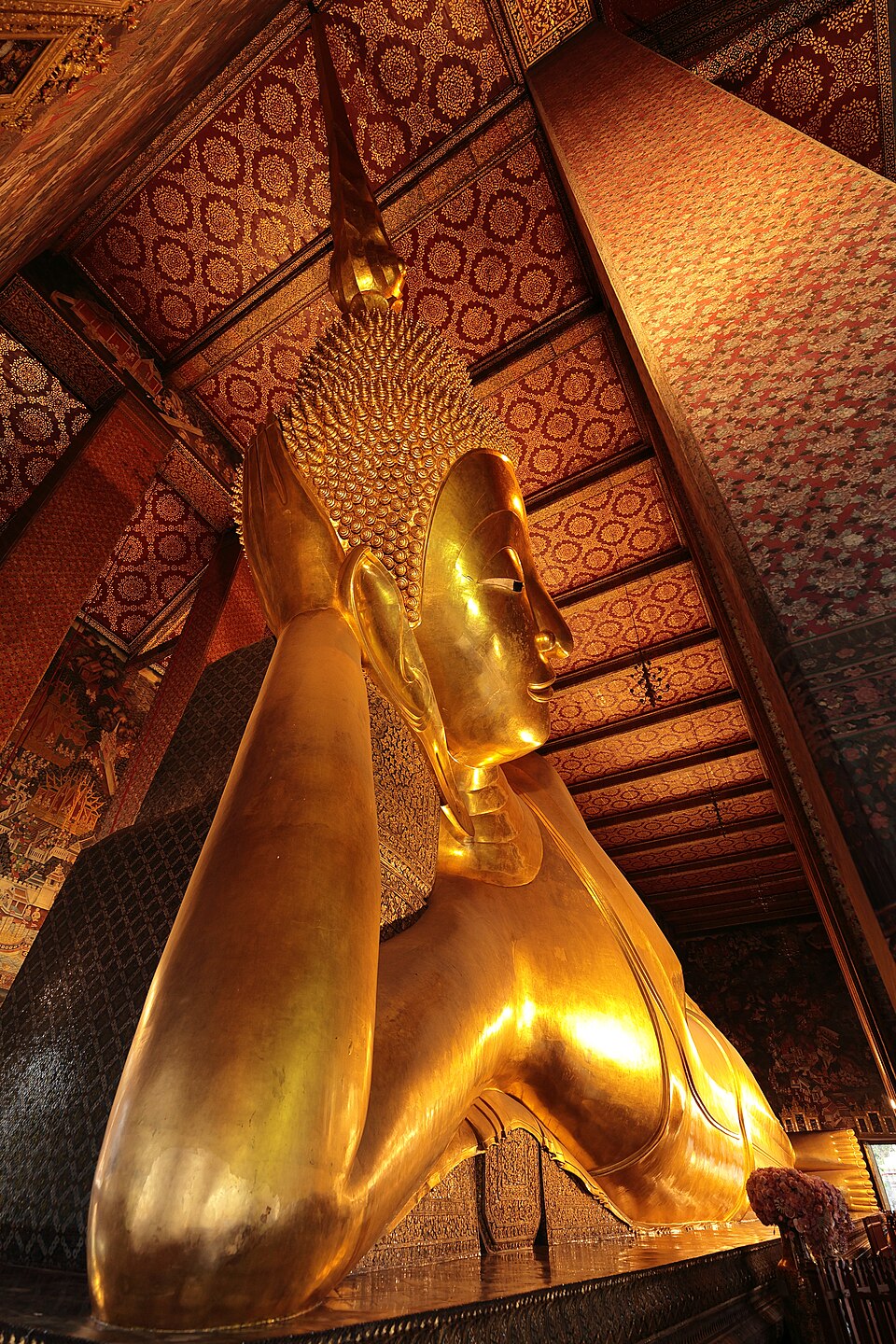
Nestled in the heart of Bangkok, adjacent to the Grand Palace, lies Wat Pho, officially known as Wat Phra Chetuphon Wimon Mangkhalaram Rajwaramahawihan. More than merely a tourist destination, Wat Pho stands as a profound sanctuary of Thai Buddhist culture, spiritual wisdom, and traditional healing arts. It is widely revered not only for its colossal Reclining Buddha but also as the birthplace of Traditional Thai Massage and a repository of ancient knowledge, reflecting centuries of spiritual devotion and scholarly endeavor.
The Ancient Roots and Enduring Legacy
Wat Pho’s history is deeply intertwined with the very fabric of Thailand. Believed to be established during the Ayutthaya period (prior to 1782), it predates Bangkok as the capital. Its current grandeur, however, largely stems from the extensive restoration and expansion commissioned by King Rama I, the founder of the Chakri Dynasty, who rebuilt it as the royal temple of the First Reign — while the Grand Palace’s Wat Phra Kaew served as the royal chapel, Wat Pho held a uniquely personal significance for the king, and his ashes remain enshrined beneath the principal Buddha image in the ordination hall to this day. Later, King Rama III transformed Wat Pho into what is considered Thailand’s first public university, inscribing medical, historical, and literary texts onto stone slabs and statues, making knowledge accessible to all.
This commitment to education and preservation of Panya Thai (Thai Wisdom) is a cornerstone of Wat Pho’s identity, embodying Buddhist principles of compassion and the pursuit of understanding for the well-being of all sentient beings.
Phra Buddhasaiyas: The Reclining Buddha and Parinirvana
The undisputed centerpiece of Wat Pho is Phra Buddhasaiyas, the magnificent Reclining Buddha. Measuring an astounding 46 meters long and 15 meters high, this gilded statue portrays the Buddha in the posture of Parinirvana – the moment of his passing into final Nirvana, transcending the cycle of rebirth (samsara). It is not merely a depiction of sleep, but a profound spiritual representation of ultimate enlightenment, peace, and liberation from worldly attachments.
The intricate details of the statue are deeply symbolic:
- The Posture: Lying on his right side, head supported by his hand, signifies tranquility and complete rest, having achieved the highest spiritual state.
- The Golden Sheen: Symbolizes the pure radiance of a fully enlightened being.
- Mother-of-Pearl Inlays on Feet: The soles of the Buddha’s feet are adorned with 108 auspicious symbols (lakshanas) of the Buddha, representing universal characteristics of enlightenment and the cosmos according to Buddhist and Hindu cosmology. These symbols encourage reverence and serve as a visual guide to the Dharma.
Observing the Reclining Buddha is an invitation to contemplate the impermanence of existence and the ultimate goal of Buddhist practice: the cessation of suffering through enlightenment.
Beyond the Iconic Statue: A Tapestry of Sacred Art and Architecture
While the Reclining Buddha often draws the most immediate attention, the entire temple complex is a rich tapestry of spiritual artistry and architectural marvels. Exploring Wat Pho reveals numerous other significant structures:
The Grand Chedis (Phra Maha Chedi Si Rajakarn)
Four towering, exquisitely tiled chedis (stupas) dominate the landscape, each dedicated to a monarch of the Chakri Dynasty. Adorned with vibrant ceramic tiles and intricate carvings, these chedis are memorials to the first four Chakri kings rather than relic stupas: the green-tiled Phra Maha Chedi Sri Sanphetdayarn, built by King Rama I, famously encases the remains of the revered Phra Si Sanphet Buddha image salvaged from the ruins of Ayutthaya, while the later chedis honor Rama II, III, and IV. Together they stand as powerful symbols of Buddhist devotion and the continuity of the Dharma across the early Rattanakosin era.
Phra Ubosot (The Ordination Hall)
The most sacred building in the temple, the Phra Ubosot, is where monks are ordained and important ceremonies take place. Inside, one finds the principal Buddha image, Phra Phuttha Thewa Patimakorn, enshrined on a magnificent golden altar. The walls are meticulously adorned with murals depicting scenes from the life of the Buddha and ancient Thai lore, offering visual lessons in Buddhist ethics and history.
The Assembly Halls (Viharns) and Pavilions (Salas)
Throughout the grounds, numerous smaller viharns house hundreds of seated Buddha images, many brought from ancient ruins across Thailand. The open-air pavilions, known as salas, provide serene spaces for contemplation and are often embellished with intricate designs, reflecting a blend of Thai and Chinese artistic influences.
Wat Pho as a Fountainhead of Traditional Thai Wisdom
Perhaps one of Wat Pho’s most significant contributions is its enduring role as a center for the preservation and dissemination of Traditional Thai Medicine (TTM), particularly Traditional Thai Massage (Nuad Thai). In 2019, Nuad Thai was officially inscribed on UNESCO’s Representative List of the Intangible Cultural Heritage of Humanity, recognizing its profound cultural and historical significance.
The temple’s open-air massage school and the inscribed marble tablets detailing human anatomy and therapeutic points are testaments to its dedication to healing and well-being, rooted in Buddhist principles of compassion and alleviating suffering. The art of Thai massage, with its focus on energy lines (sen) and mindful manipulation, is seen as a holistic practice that nurtures both body and spirit, echoing the compassionate healing practices attributed to the Buddha’s own physician, Jivaka Komarabhacca.
Beyond massage, Wat Pho’s epigraphic archives encompass a vast array of knowledge: history, literature, astrology, and herbal medicine, establishing it as a living museum and a guardian of Thai cultural heritage.
Experiencing Wat Pho: A Journey of Reflection
Visiting Wat Pho is not merely sightseeing; it is an immersive experience. The serene atmosphere, the chanting of monks, the scent of incense, and the intricate beauty of the architecture invite a sense of peace and introspection. It is an opportunity to practice mindfulness, to reflect on the teachings of the Dharma, and to appreciate the profound cultural and spiritual legacy that Thailand has so carefully preserved.
To walk the grounds of Wat Pho is to walk through centuries of devotion, wisdom, and an unwavering commitment to the path of enlightenment – a timeless reminder of the enduring power of the Buddha’s message.
Frequently Asked Questions (FAQ) & Key Concepts
Q: What is the main spiritual purpose of Wat Pho?
Wat Pho is a first-class royal monastery and an active center of Buddhist practice: monks are ordained and ceremonies held in its Phra Ubosot, devotees pay respects before the Reclining Buddha as a contemplation of the Buddha’s Parinirvana, and the temple preserves and teaches traditional Thai knowledge — from Dharma study to Nuad Thai massage — continuing its historic role as a place of both worship and learning.
Q: What does the Reclining Buddha (Phra Buddhasaiyas) symbolize?
The Reclining Buddha symbolizes the Buddha’s Parinirvana, representing his passing into ultimate enlightenment and complete liberation from the cycle of rebirth, not merely a depiction of sleep.
Q: What is the significance of Wat Pho’s Traditional Thai Massage school?
Wat Pho is considered the birthplace and leading center for preserving Traditional Thai Massage (Nuad Thai), a holistic healing art recognized by UNESCO, rooted in ancient medical knowledge and Buddhist principles of compassion.
Q: How old is Wat Pho, and who was instrumental in its development?
Wat Pho predates Bangkok as the capital, with origins in the Ayutthaya period. Its current grandeur was largely established by King Rama I, and King Rama III further developed it into a public center for traditional Thai wisdom and education.
Q: Are there other important structures besides the Reclining Buddha?
Yes, Wat Pho features four magnificent Grand Chedis (stupas), the sacred Phra Ubosot (ordination hall), numerous smaller viharns housing Buddha images, and pavilions all rich in spiritual and artistic significance.
Q: What are the 108 auspicious symbols on the Reclining Buddha’s feet?
These intricate mother-of-pearl inlays represent 108 auspicious characteristics of the Buddha and universal symbols from Buddhist and Hindu cosmology, guiding practitioners towards deeper understanding of the Dharma.