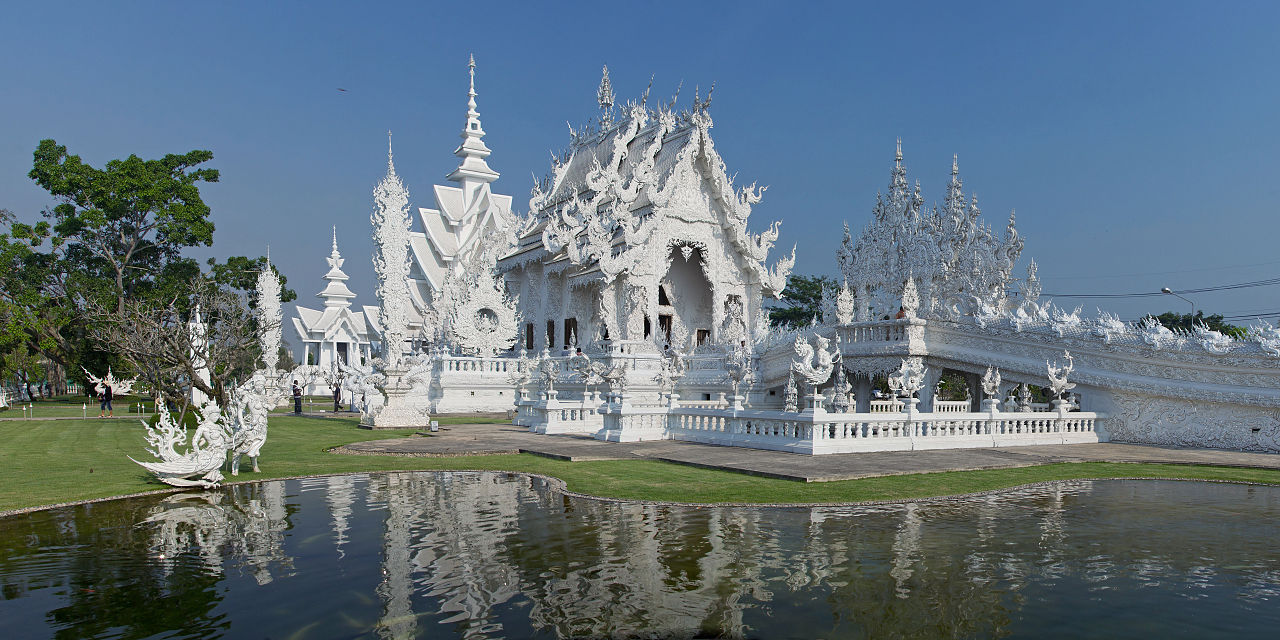
In the northern reaches of Thailand, nestled amidst the verdant landscapes of Chiang Rai, stands a creation that transcends mere architecture to become a profound spiritual journey – Wat Rong Khun. More commonly known as the White Temple, this unique edifice is not an ancient relic, but a contemporary masterpiece, a living testament to Buddhist philosophy rendered in a dazzling, unconventional form. It is a contemplative space, conceived by the visionary artist Ajarn Chalermchai Kositpipat, intended as an offering to the Buddha and a powerful narrative on the path to enlightenment.
The Visionary Master: Ajarn Chalermchai Kositpipat
Wat Rong Khun is the magnum opus of National Artist Ajarn Chalermchai Kositpipat, a devout Buddhist and celebrated painter. His ambition was not simply to build a temple, but to create a work of art that would serve as a powerful teaching tool for the Dharma, inspiring reflection on the impermanence of life, suffering, and the pursuit of inner peace. Commencing construction in 1997, Ajarn Chalermchai dedicated his personal wealth and artistic prowess to this lifelong project, seeing it as an act of merit-making (tham bun) for the benefit of all beings. He envisioned a temple that would endure for centuries, a beacon of Buddhist wisdom for future generations.
A Tapestry of Dhamma: Decoding the Symbolism
Every intricate detail of Wat Rong Khun is imbued with deep Buddhist symbolism, guiding the visitor through a metaphorical journey from the defilements of the earthly realm to the purity of Nirvana. The stark white color, adorned with shimmering glass shards, represents the Buddha’s purity and wisdom, while the glass symbolizes the Dharma, shining throughout the universe.
The Bridge of the Cycle of Rebirth (Saṃsāra)
The journey begins before even reaching the main temple hall (Ubosot), with a crossing over a small lake. Here, a terrifying yet poignant scene unfolds: hundreds of desperate, grasping hands reach up from a chasm below the bridge. These symbolize untold suffering and unfulfilled desires, representing hell and the cycle of rebirth (Saṃsāra). This powerful imagery serves as a stark reminder of the consequences of craving and attachment.
The bridge itself, leading away from these grasping hands, signifies the path of escaping suffering through the teachings of the Buddha. To cross it means to rise above temptation and worldly desires, moving towards spiritual liberation.
The Gate of Heaven
At the end of the bridge stand two imposing figures, the ‘Gate of Heaven’ guardians – celestial beings believed to decide the fate of the dead. These figures represent the choices one makes in life, leading either towards enlightenment or further entanglement in Saṃsāra. Passing them, one steps into a purified realm, leaving the karmic burdens of the past behind.
The Ubosot: The Apex of Purity
The main ordination hall, or Ubosot, is the centerpiece of Wat Rong Khun. Its dazzling white façade, intricately carved with celestial beings, mythical creatures, and traditional Thai motifs, radiates an ethereal glow. The shimmering glass embedded within the plaster reflects sunlight, creating a dynamic interplay of light that underscores the purity and brilliance of the Dharma. The Ubosot is a symbol of the Buddha’s mind, a pure space untouched by defilement.
The Inner Sanctum Murals: A Modern Reflection
Inside the Ubosot, the traditional murals take a decidedly contemporary turn. While the exterior speaks of ancient wisdom, the interior walls present a fascinating, often unsettling, depiction of modern evils and societal ills. Images of war, terrorism, environmental destruction, and figures from popular culture (such as superheroes or cinematic villains, representing the forces of temptation and distraction) are juxtaposed with Buddhist deities. This powerful narrative reminds visitors that suffering (Dukkha) is ever-present in the modern world, and the path to liberation requires mindfulness and adherence to the Dharma in contemporary contexts. The back wall features a golden mural of the Buddha, signifying the ultimate goal of Nirvana.
The Golden Building
Contrasting sharply with the brilliant white Ubosot is a separate, entirely golden building. This structure, often mistaken for another temple hall, actually serves as the temple’s restroom facilities. Its golden hue symbolizes worldly desires, material possessions, and the allure of wealth that often distracts from spiritual pursuits. Its placement opposite the pure white Ubosot serves as a clever metaphor for the dichotomy between material attachment and spiritual enlightenment, a profound commentary on societal values.
Architectural Brilliance and Artistic Innovation
Ajarn Chalermchai’s vision seamlessly blends traditional Thai Buddhist architecture with highly inventive, fantastical elements. The intricate carvings, the multi-tiered roofs, and the Naga (mythical serpent) balustrades are characteristic of classic Thai temples, yet the execution is entirely unique. The use of modern materials, particularly the countless shards of mirror and glass, elevates Wat Rong Khun from a mere structure to a living, breathing artwork that shifts and sparkles with every change in light. This innovative approach ensures that the temple is not just a place of worship, but also a dynamic canvas for spiritual expression and reflection.
A Living Legacy of Faith and Art
Wat Rong Khun is not a finished work; it is an ongoing project, constantly evolving under Ajarn Chalermchai’s guidance and supported by donations. He envisions it eventually comprising nine buildings, each with its own unique symbolism. It stands as a testament to the enduring power of faith, art, and the intention to create merit for the greater good. It is a pilgrimage site for both devout Buddhists seeking spiritual reflection and art enthusiasts drawn to its unparalleled beauty and conceptual depth.
Visiting Wat Rong Khun is an invitation to engage in a meditative journey, to confront the complexities of existence, and to contemplate the timeless wisdom of the Buddha’s teachings through the lens of contemporary art. It is a profound reminder that the path to inner peace is an active, mindful pursuit, beautifully articulated in white and gold amidst the serenity of Chiang Rai.
Frequently Asked Questions (FAQ) & Key Concepts
Q: What is the main spiritual purpose of Wat Rong Khun?
The primary purpose of Wat Rong Khun is to serve as a sacred reminder of Buddhist teachings, offering deep spiritual protection, mindfulness, and karmic blessings to practitioners who hold pure intentions, all conveyed through artistic symbolism.
Q: Who is the artist behind Wat Rong Khun and what was his inspiration?
Wat Rong Khun was conceived and designed by renowned Thai artist Ajarn Chalermchai Kositpipat, who dedicated his life and personal fortune to creating this unique temple as an offering to the Buddha and as a center for Buddhist art.
Q: Why is Wat Rong Khun predominantly white?
The dazzling white color of the temple symbolizes the purity of the Buddha and the wisdom of the Dharma, while the shimmering glass embedded within represents the Dharma shining throughout the universe.
Q: What does the ‘Bridge of the Cycle of Rebirth’ symbolize?
The ‘Bridge of the Cycle of Rebirth’ (Saṃsāra) with its outstretched hands symbolizes the suffering and desires of hell and the worldly realm, illustrating the arduous path one must cross to achieve liberation from defilements.
Q: Is Wat Rong Khun a traditional functioning temple?
While Wat Rong Khun incorporates traditional Buddhist temple elements and functions as a spiritual center, it is fundamentally an unconventional, ongoing art project intended to convey Buddhist teachings in a contemporary and accessible manner, rather than strictly adhering to all traditional monastic activities.
Q: How does Wat Rong Khun incorporate contemporary elements into Buddhist art?
The temple uniquely blends traditional Thai architectural forms with modern artistic interpretations, notably through its stunning white and glass aesthetic and the provocative interior murals that depict modern evils and pop culture figures alongside classic Buddhist imagery, encouraging reflection on the Dharma in today’s world.