
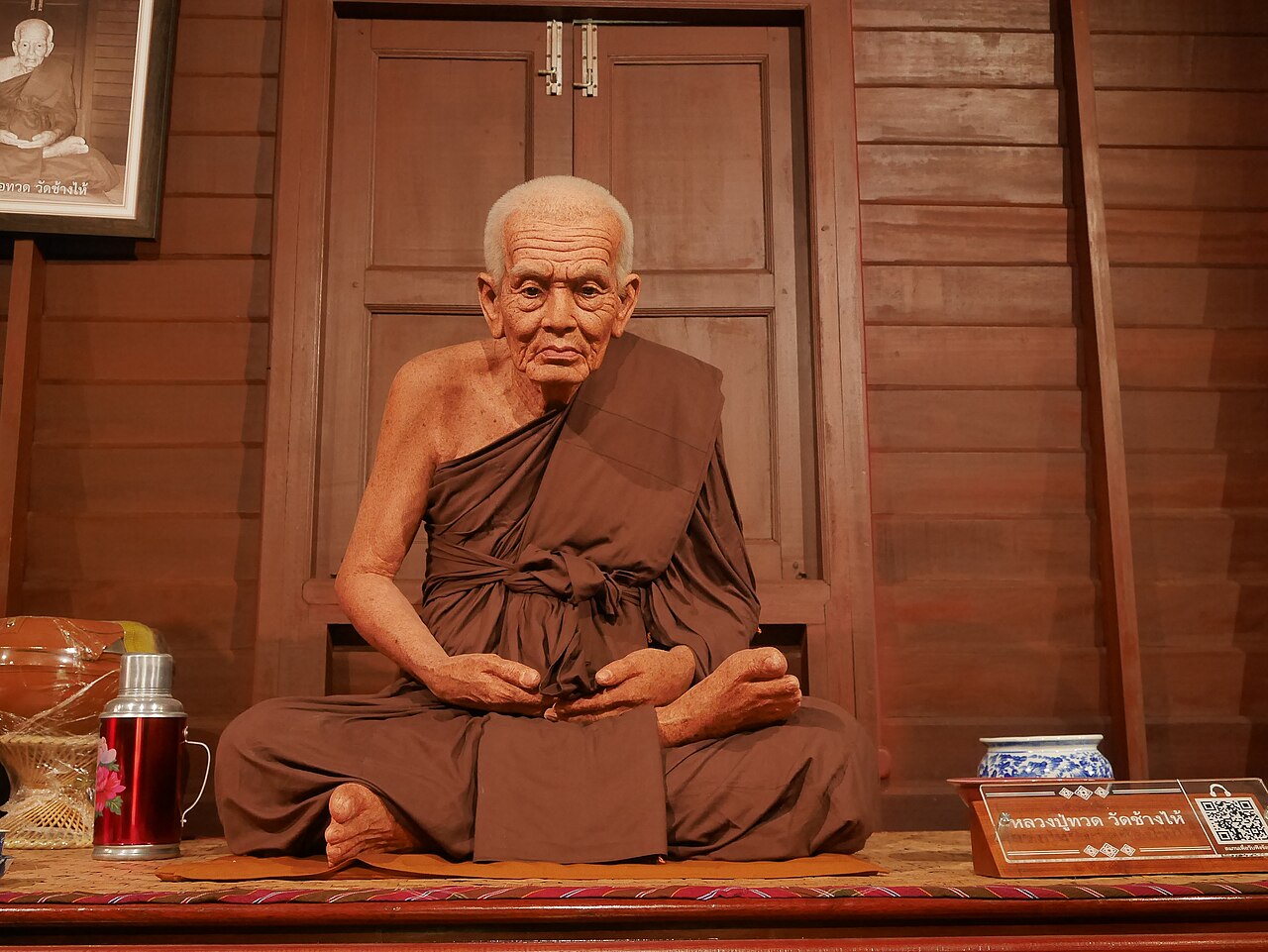
Luang Pu Thuat (หลวงปู่ทวด, also written Luang Phor Thuad or LP Tuad) was a Buddhist monk of the Ayutthaya period, traditionally said to have lived from around 1582 to 1682 (BE 2125–2225). He is Thailand’s most legendary guru monk, revered above all for the miracle of turning seawater into fresh drinking water, and he is forever associated with Wat Chang Hai in Pattani province, where the first amulets bearing his image were created in BE 2497 (1954). Those amulets are today among the most venerated — and most valuable — in the entire Thai amulet tradition, worn by devotees across Thailand, Malaysia and Singapore for protection from danger.
This article traces what temple chronicles and folk tradition tell us about his life, the legends that made him a household name in every Thai province, and the history of the Wat Chang Hai amulets that carry his blessing.
Who Was Luang Pu Thuat?
His formal ecclesiastical title was Somdet Phra Rajamuni Samiram Khunupamacharn, and in the south he is also remembered as Somdet Chao Phako, after Wat Phako in Songkhla where he served as abbot. Published biographies describe him as a prominent monk of the Ayutthaya Kingdom who spent much of his life in southern Siam. Because he lived more than three centuries ago, his story is preserved largely through temple chronicles and oral tradition rather than contemporary documents, and even his birth year is disputed: Thai researchers have proposed dates ranging from BE 2090 to BE 2131 (1547–1588 CE), with BE 2125 (1582) the most commonly cited.
What is beyond dispute is his standing. Together with Somdej Phra Buddhachan Toh (Somdej Toh) of Wat Rakhang, Luang Pu Thuat is regarded as one of the two most widely venerated master monks in Thailand, and images of the two are often enshrined side by side on Thai altars.
Early Life and Legends
According to the chronicles, Luang Pu Thuat was born at Ban Wat Liap in Sathing Phra district, Songkhla province, to a poor couple named Hu and Chan, who worked in debt bondage for a wealthy landlord named Pan. His birth name was simply Pu. Tradition records that strange omens — thunder and tremors — accompanied his birth.
The most famous legend of his infancy tells how his mother, working in the rice fields, found a great snake coiled around her baby’s cradle. After she prayed and made offerings, the snake slipped away, leaving a luminous crystal bead on the child’s chest. The bead brought misfortune to the landlord who tried to seize it, and when he returned it and forgave the family’s debts, their fortunes turned. The crystal later became a sacred relic associated with Wat Phako.
At about seven years old the boy was sent to study at Wat Kut Luang (today Wat Dee Luang) under the abbot, who was his uncle. He proved exceptionally quick at learning both Thai and Khmer scripts, was ordained as a novice at fifteen, and continued his education under senior monks before travelling to Wat Sema Muang in Nakhon Si Thammarat for higher studies. After full ordination he became renowned for his learning and meditative attainments, and tradition holds that he was honoured in Ayutthaya by King Ekathotsarot with the lofty title Somdet Phra Rajamuni Samiram Khunupamacharn.
The Miracle of the Fresh Seawater
The defining legend of Luang Pu Thuat took place on a sea voyage from the south toward Ayutthaya. When the ship was halted at sea — becalmed in some tellings, seized by hostile crewmen in others — the drinking water ran out, and the sailors blamed the monk on board for their misfortune. Luang Pu Thuat calmly lowered his foot over the side of the boat and drew a circle in the sea. Within that circle the saltwater turned fresh, and the astonished crew drank their fill and begged his forgiveness.
“Luang Pu Thuat Yiap Nam Thale Jued” — Luang Pu Thuat who stepped on the seawater and made it fresh — remains the epithet by which every Thai knows him to this day.
Wat Chang Hai and His Final Years
In his later years Luang Pu Thuat returned south, residing at Wat Phako and, according to the tradition cherished in Pattani, guiding disciples at Wat Chang Hai Rat Buranaram in Khok Pho district. The temple’s name — roughly “the elephant gave” — comes from a Pattani chronicle tradition: a local ruler seeking an auspicious site is said to have released a royal elephant and followed it into the forest, and where the elephant circled and trumpeted three times, the temple was founded. He is recorded to have passed away on 6 March BE 2225 (1682), at the age of about one hundred, in the Sai Buri region further down the peninsula. In keeping with his instructions, his remains were carried back to Khok Pho, and the stupa containing his relics at Wat Chang Hai became — and remains — one of the great pilgrimage destinations of southern Thailand.
The Wat Chang Hai Amulets
The First Batch: Nuea Wan, BE 2497 (1954)
Luang Pu Thuat amulets were first created nearly three centuries after his death. In 1954 the abbot of Wat Chang Hai, Ajahn Tim Dhammadharo (Phra Khru Wisai Sophon, 1912–1969), joined with the Pattani benefactor Anan Kananurak to produce sacred images of the great master in order to raise funds for the temple’s ordination hall (ubosot). The amulets were pressed from nuea wan — a paste of sacred herbs and pollens — and consecrated in a great ceremony at Wat Chang Hai on 18 April BE 2497 (1954), with Ajahn Tim presiding alongside other southern masters.
Reports place the first batch at roughly 64,000 pieces in several moulds (phim), including the large Phim Yai, medium Phim Klang and smaller designs. Devotees credited the amulets with miraculous protection almost immediately, and demand grew so fast that the batch passed into legend as one of the most important amulet issues of the twentieth century.
Later Editions: BE 2500, 2504 and the 2505 Lang Taolit
Wat Chang Hai followed the 1954 batch with metal coin (rian) editions in BE 2500 (1957) and BE 2504 (1961), and in BE 2505 (1962) released the famous lang taolit series — cast images whose flat backs resemble a traditional flatiron. Lang taolit amulets exist with plain backs and with inscribed backs (lang nangsue), and collectors distinguish several moulds of varying sharpness. A further landmark of the period is the BE 2508 (1965) lueang samanasak (“rank-promotion”) coin, struck to mark Ajahn Tim’s ecclesiastical elevation and today among the most coveted and valuable of all Luang Pu Thuat coins. Editions continued under Ajahn Tim until BE 2512 (1969), and temples throughout Thailand have issued Luang Pu Thuat images ever since.
Notes for Collectors
Genuine early Wat Chang Hai pieces — above all the 2497 nuea wan and the 2505 lang taolit — now command very high prices at auction, and the market is crowded with copies. As with the Phra Somdej amulets of Somdej Toh, study reference photographs, insist on provenance or certification from a recognised amulet association, and buy from dealers you trust. Later temple editions remain affordable and are made with the same devotional intent; you can browse authenticated pieces in our shop.
Why Devotees Wear Luang Pu Thuat Amulets
Luang Pu Thuat amulets are worn above all for klaew klaad — escape from mortal danger. Thai newspapers have reported countless testimonies of devotees surviving road accidents, and the amulets are especially popular with drivers, soldiers, sailors and travellers. In the South, parents traditionally pin a small Luang Pu Thuat image to a newborn’s clothing for protection. The faith extends well beyond Thailand: shrines to Luang Pu Thuat stand in Malaysia and Singapore, and his image is among the most recognised Buddhist images in Southeast Asia. You can read about other revered masters in our guides to Thailand’s great monks.
Frequently Asked Questions
Who is Luang Pu Thuat?
Luang Pu Thuat was a revered Buddhist monk of the Ayutthaya period, traditionally dated 1582–1682 (BE 2125–2225). Born in Songkhla and honoured in Ayutthaya, he is most associated with Wat Chang Hai in Pattani, and amulets bearing his image are among Thailand’s most venerated protective amulets.
Did Luang Pu Thuat really turn seawater into fresh water?
The seawater miracle is a legend preserved through southern Thai chronicles and oral tradition rather than verifiable history. Tradition says that during a sea voyage he dipped his foot into the ocean and drew a circle, turning the water within it fresh, which earned him his famous epithet.
What is the Luang Pu Thuat 2497 amulet?
The BE 2497 (1954) amulet is the first Luang Pu Thuat amulet ever made. Created at Wat Chang Hai by Ajahn Tim with benefactor Anan Kananurak, it was pressed from sacred herbal paste (nuea wan), consecrated on 18 April 1954, and reportedly numbered about 64,000 pieces in several moulds.
Where is Wat Chang Hai?
Wat Chang Hai Rat Buranaram is in Khok Pho district, Pattani province, in Thailand’s deep south, roughly 30 kilometres from Pattani town. The temple houses the shrine and relics of Luang Pu Thuat and remains a major pilgrimage destination, easily reached by road or by the Khok Pho railway station.
What are Luang Pu Thuat amulets believed to do?
Devotees wear them chiefly for protection from accidents, violence and mortal danger — the quality Thais call klaew klaad. Many also regard them as bringing safe travel and general good fortune. Buddhist teaching adds that the amulet works together with the wearer’s own morality and mindfulness.
Sources
- Luang Pu Thuat — Wikipedia
- Phra Khru Wisai Sophon (Tim Dhammadharo) — Thai Wikipedia
- Phra Somdej Mueang Tai: Luang Pu Thuat Wat Chang Hai, nuea wan, first batch BE 2497 — Thairath
- Notes on the history of Phra Ajahn Tim of Wat Chang Hai, Pattani — Komchadluek
- Luang Pu Thuat nuea wan BE 2497: all moulds and authentication points — ENNXO
- Luang Pu Thuat Large Iron-Back Amulet, 1962, Wat Chang Hai — Thairath English
- Luang Pho Thuat who stepped on the sea: from history to a living legend — Lek-Prapai Viriyahpant Foundation