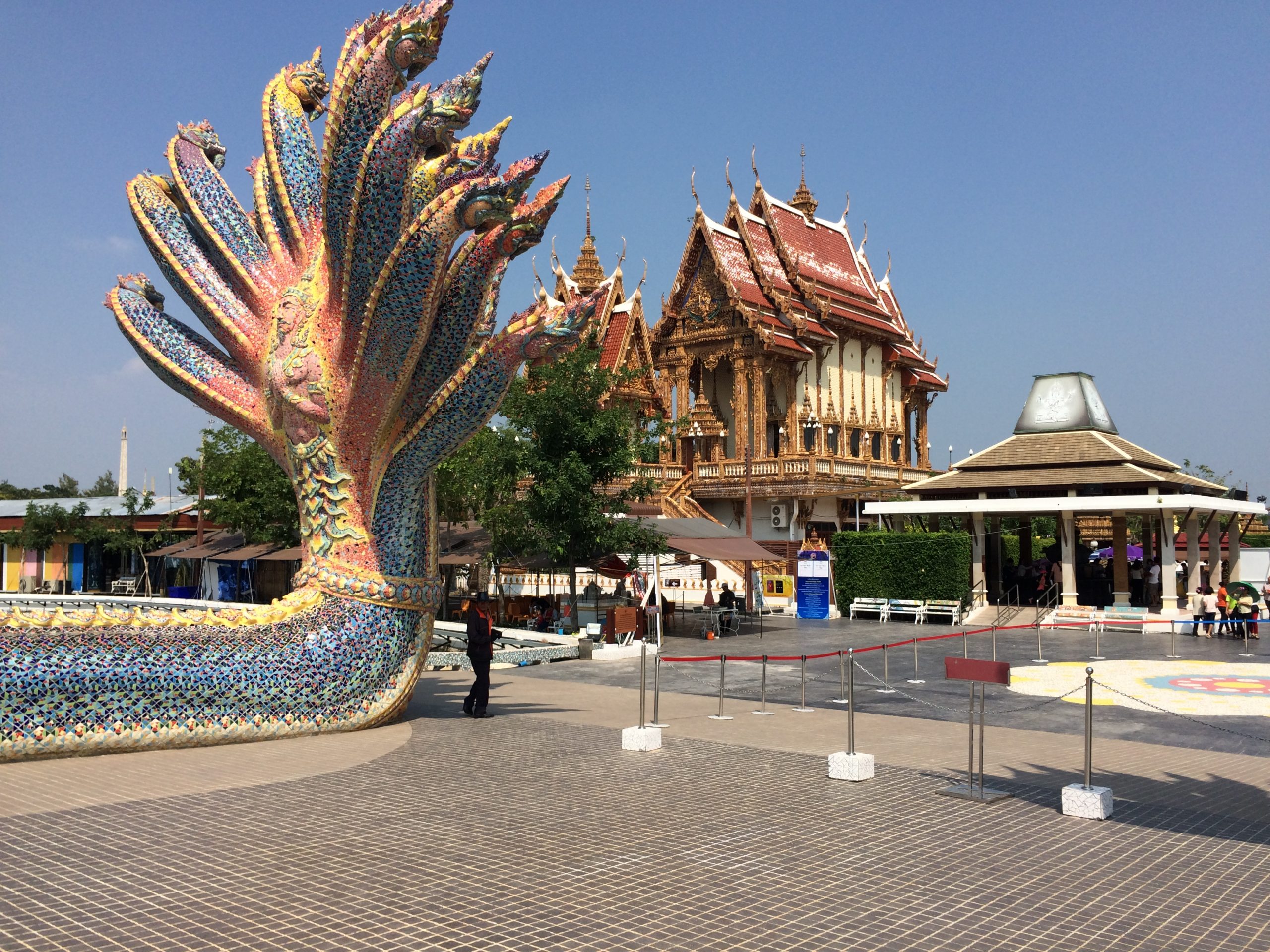
Wat Ban Rai (วัดบ้านไร่) is a Buddhist temple in Kut Phiman subdistrict, Dan Khun Thot district, Nakhon Ratchasima province, in Thailand’s lower northeast. It is famous nationwide as the home temple of Luang Phor Koon Parisuttho (1923–2015), one of the most beloved monks of the modern era, and as the site of the Thep Wittayakhom Vihara — a four-storey hall built in the shape of a colossal elephant and sheathed in more than twenty million ceramic mosaic tiles, widely described as the largest ceramic-mosaic structure in Asia. What began in the 1890s as a tiny village monastery on the dry Korat plateau is today one of the great pilgrimage destinations of Isan, drawing busloads of devotees who come to honour the old monk, walk the elephant building and tour the museum that preserves his story.
A Village Monastery from the Reign of Rama V
Wat Ban Rai takes its name from Ban Rai, the farming village it serves. Thai records trace the community’s monastic residence back to around 1893 (BE 2436), in the reign of King Chulalongkorn (Rama V), when it functioned as a simple samnak song — a monks’ dwelling rather than a fully consecrated temple. Its first abbot is remembered as Phra Ajarn Chuam Wirotho, a teacher monk of the old Korat school who instructed village boys in Thai and Khmer scripts and in the protective lore of the countryside.
One of those village boys was Koon Chatphonkrang, born in Ban Rai in October 1923 (BE 2466). After his mother died when he was around eleven, his father placed him in the care of the temple, where Phra Ajarn Chuam and two other teachers, Phra Ajarn Chai and Phra Ajarn Lee, gave him his first education. The boy would return decades later as a monk and transform the little monastery beyond recognition.
Luang Phor Koon and the Growth of Wat Ban Rai
Luang Phor Koon was ordained on 5 May 1944 (BE 2487) at Wat Thanon Hak Yai in Kut Phiman, received the monastic name Parisuttho (“the completely pure one”), and spent his early years in meditation training and thudong wandering that took him deep into the forests of Laos and Cambodia. He returned to Wat Ban Rai in 1952 (BE 2495), and from 1953 (BE 2496) began turning the run-down village monastery into a real temple: an ordination hall, monks’ quarters, a sermon hall, a pond to supply the village with water, and a school for local children.
Over the following six decades, as his fame as an amulet master and blunt-spoken man of the people spread across Thailand, Wat Ban Rai became the engine of one of the largest charitable programmes ever run from a single Thai temple. Donation ledgers kept from 1970 (BE 2513) onwards record well over five billion baht given away — hospitals, schools, a technical college, roads and temples across the Northeast. On 11 January 1995 (BE 2538), King Bhumibol Adulyadej and Queen Sirikit travelled to Wat Ban Rai in person, where Luang Phor Koon presented 72 million baht to royal charities.
“People give me money to make merit, so it is my duty to pass it on. The more you give, the more you have.” — Luang Phor Koon Parisuttho
The monk’s royal ecclesiastical titles trace the temple’s rise with him: Phra Yan Witthayakhom (1992), Phra Ratcha Witthayakhom (1996) and finally Phra Thep Witthayakhom (2004) — the title that now names the temple’s most spectacular building. The full story of his life, his head-knock blessing and his legendary coin amulets is told in our biography of Luang Phor Koon.
The Thep Wittayakhom Vihara: The Elephant Building
The image that has come to define Wat Ban Rai rises straight out of a lake: a gigantic, glittering elephant, its trunk curled around a vase of lotus flowers, carrying a four-storey vihara on its back. The Thep Wittayakhom Vihara stands in a roughly 30-rai (about 4.8-hectare) pond in the temple’s Dhamma park. Construction began in honour of King Bhumibol’s 84th birthday in 2011 (BE 2554), and the building was completed in 2013 (BE 2556), the year of Luang Phor Koon’s own 90th birthday — and only two years before his death.
A Tripitaka in Mosaic
The vihara was conceived as a “vihara of the Tripitaka”: a building that narrates the Buddha’s story and teachings in architecture, sculpture and contemporary mural art rather than in palm-leaf text. Its four levels — including one basement floor — carry visitors from the mythological underwater realm of the naga, guarded at the approach by a nineteen-headed naga sculpture, up through halls of paintings and reliefs on the Buddha’s life and the Dhamma, to a rooftop terrace where a large Buddha image sits beside a gold-covered statue of Luang Phor Koon overlooking the Korat countryside.
Twenty Million Tiles, Laid by Devotees
The entire structure is covered in more than twenty million pieces of ceramic mosaic, which is why Thai media routinely call it the largest ceramic-mosaic building in Asia. Remarkably, much of the mosaic was laid by ordinary devotees rather than contractors: volunteers were permitted to set no more than one square metre of tiles a day, so that the work proceeded as an act of mindfulness and merit rather than mere construction. The result is a surface that shifts colour with the light, doubled by its reflection in the surrounding water.
The Luang Phor Koon Museum
Within the temple grounds stands the Luang Phor Koon Museum (Phiphitthaphan Luang Phor Koon Parisuttho), a two-storey building arranged into ten themed zones that follow the monk’s life from village boyhood through ordination, thudong wandering, temple building, his amulet editions and his vast charitable giving. Exhibits include his robes, personal effects, photographs and a lifelike figure of the monk in his famous flat-footed squat. The museum is open daily, normally from about 08:00 to 17:00, and entry is free, making it an easy and worthwhile companion to the vihara visit.
Wat Ban Rai After Luang Phor Koon
Luang Phor Koon died on 16 May 2015 (BE 2558) in his 92nd year. True to a will he had signed back in 1993, his body was not enshrined at the temple: it was donated to the Faculty of Medicine at Khon Kaen University as a cadaver for medical students — an ajarn yai, or “great teacher” — and after serving that purpose was cremated with the year’s other donors in January 2019 at the Isan Buddhamonthon grounds of Wat Nong Waeng in Khon Kaen. His ashes were scattered in the Mekong River at Nong Khai. Visitors should therefore understand that there is no tomb or relic stupa of Luang Phor Koon at Wat Ban Rai; what remains is the temple he built and the institutions his amulets funded.
The temple has continued to develop as a pilgrimage and merit-making centre. In 2024 (BE 2567) it announced plans for a new landmark: the world’s largest statue of Luang Phor Koon, seated in his trademark squat, intended to welcome the faithful for generations to come. Wat Ban Rai amulets associated with the master remain among the most heavily collected in Thailand — you can browse pieces from many famous temples in our amulet shop.
Visiting Wat Ban Rai: Practical Guide
Wat Ban Rai lies in Kut Phiman subdistrict, Dan Khun Thot district, roughly 60–70 kilometres northwest of Nakhon Ratchasima city — about an hour to ninety minutes by car from Korat, and a comfortable day trip by private car or tour bus from Bangkok. The grounds are open daily; the Thep Wittayakhom Vihara is generally open from about 08:30 to 17:00, and outside those hours only the exterior and ground level can be viewed. Entry to both the vihara and the museum is free, though donations are welcomed and fund the temple’s continuing charitable work.
Dress modestly, as at any Thai temple: shoulders and knees covered, shoes off inside the halls. Weekends and Buddhist holy days are busiest, with merit-making crowds from across Isan; arrive early for quiet light over the lake. For more temple guides, see our Temples section.
Frequently Asked Questions
Where is Wat Ban Rai located?
Wat Ban Rai is in Ban Rai village, Kut Phiman subdistrict, Dan Khun Thot district, Nakhon Ratchasima province, roughly 60–70 kilometres northwest of Korat city. Most visitors come by private car or organised tour, as the temple sits in farming country well off the main rail and bus corridors.
What is the giant elephant building at Wat Ban Rai?
It is the Thep Wittayakhom Vihara, a four-storey hall shaped like a colossal elephant standing in a 30-rai lake. Completed in 2013 (BE 2556) and named after Luang Phor Koon’s ecclesiastical title, it is covered in over twenty million ceramic mosaic tiles and presents the Buddha’s life and teachings floor by floor.
Is Wat Ban Rai free to visit, and when is it open?
Yes. The temple grounds, the Thep Wittayakhom Vihara and the Luang Phor Koon Museum are all free to enter. The vihara is generally open from about 08:30 to 17:00 and the museum from about 08:00 to 17:00 daily. Donations support the temple’s charitable projects in the region.
Is Luang Phor Koon’s body kept at Wat Ban Rai?
No. Following his 1993 will, his body was donated to Khon Kaen University’s Faculty of Medicine as a teaching cadaver, cremated in January 2019, and his ashes were scattered in the Mekong River. Wat Ban Rai honours him through its museum, statues and the buildings his donations created.
Why is Wat Ban Rai so important to amulet collectors?
Luang Phor Koon consecrated hundreds of amulet editions over five decades, and the most famous batches — BE 2512, 2517, 2519 and the 1993–1995 golden era — rank among the most traded Thai amulets ever. Their sales financed hospitals and schools, which is part of their enduring appeal to collectors.
Sources
- วัดบ้านไร่ (อำเภอด่านขุนทด) — Thai Wikipedia
- วัดบ้านไร่ — Nakhon Ratchasima Provincial Office travel guide
- Ban Rai Temple (Wat Ban Rai) — Tourism Authority of Thailand
- พิพิธภัณฑ์หลวงพ่อคูณ วัดบ้านไร่ — Tourism Authority of Thailand (Thai)
- หลวงพ่อคูณ ปริสุทฺโธ พระนักพัฒนาสร้างทานบารมี — Silpa-Mag
- วิหารเทพวิทยาคม มรดกวัฒนธรรม ณ วัดบ้านไร่ — Sanook Travel
- วิหารเทพวิทยาคม วัดบ้านไร่ — Kapook Travel
- “หลวงพ่อคูณ” มรณภาพแล้ว — Thai PBS
- พิพิธภัณฑ์หลวงพ่อคูณ ปริสุทฺโธ — Museum Thailand
- วัดบ้านไร่ สร้างแลนด์มาร์ค “หลวงพ่อคูณ” องค์ใหญ่ที่สุดในโลก — Amarin TV