Wat Suthat Thepwararam is one of the oldest and most important first-class royal temples in Bangkok, founded by King Rama I in BE 2350 (1807 CE) to enshrine a great Sukhothai-era bronze Buddha. Best known today for the towering red Giant Swing (Sao Ching Cha) that stands at its gates, the temple is also the birthplace of the famous Phra Kring amulets cast by Somdej Phra Sangkharat (Pae) and a revered centre for Thao Wessuwan worship.
Set in the historic Rattanakosin district near Bangkok City Hall, Wat Suthat brings together royal history, exceptional craftsmanship and a living amulet-making tradition that collectors prize to this day. This guide explains the temple’s founding, its sacred principal Buddha, the meaning of the Giant Swing, and the amulets that make Wat Suthat a household name among devotees.
The founding of Wat Suthat Thepwararam
King Rama I (Phra Phutthayotfa Chulalok) commissioned the temple in BE 2350 (1807 CE) and originally named it Wat Maha Suthawat. He intended it to stand at the very centre of the new capital, mirroring the importance that Wat Phra Si Sanphet held in the former capital of Ayutthaya. The king did not live to see it finished; construction continued through the reign of King Rama II and was only completed during the reign of King Rama III (1824–1851), who gave the temple its present name, Wat Suthatthepwararam.
Wat Suthat holds the rank of phra aram luang chan ek chanit ratchaworamahawihan, a first-class royal monastery of the highest grade. It is also the official temple of King Rama VIII, King Ananda Mahidol, whose royal ashes are interred beneath the base of the principal Buddha image. That royal connection gives the temple a quiet solemnity that sets it apart from Bangkok’s busier tourist temples.
Phra Si Sakyamuni: the sacred Sukhothai Buddha
At the heart of the temple’s grand wihan sits Phra Si Sakyamuni, affectionately called Luang Pho To. Cast in bronze during the Sukhothai period roughly 660–670 years ago, the image stands about eight metres tall and is one of the largest surviving Sukhothai bronze Buddhas in Thailand. It depicts the Buddha in the marawichai (subduing Mara) posture, seated with the right hand touching the earth.
The image was originally the principal Buddha of the royal wihan at Wat Mahathat in Sukhothai. King Rama I had it floated down by river to Bangkok to serve as the temple’s centrepiece, a journey so significant that the king is said to have walked barefoot to receive it. During the reign of King Rama II, the king personally took part in carving details of the temple’s wooden doors and later ordered refinements to the Buddha image, including reshaping the head and lengthening the fingers so that they were even.
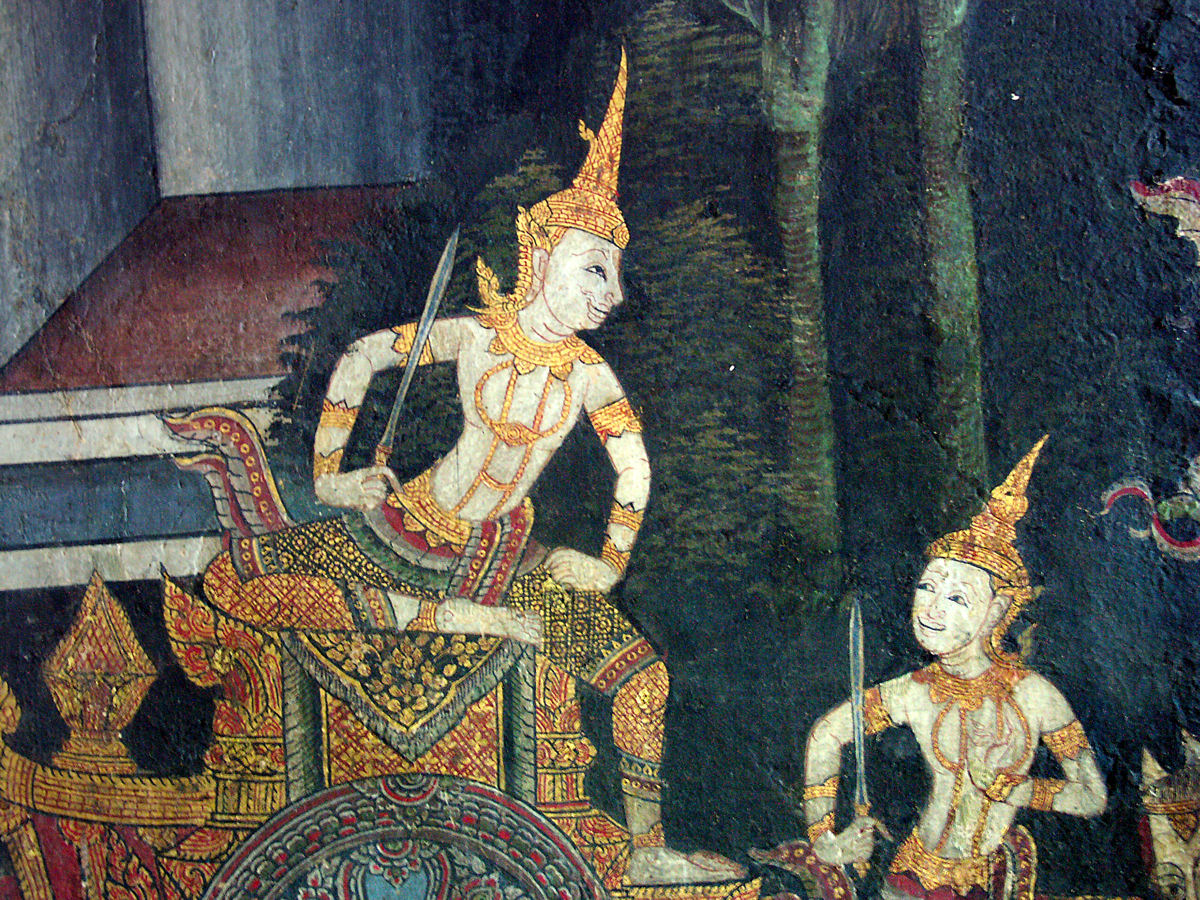
The walls of the wihan are covered with murals depicting the twenty-four previous Buddhas, while the surrounding cloister shelters around 156 seated Buddha images, making Wat Suthat one of the finest galleries of Buddhist art in the capital.
The Giant Swing (Sao Ching Cha)
The bright red Giant Swing standing in the plaza in front of Wat Suthat is among Bangkok’s most recognisable landmarks. Rising about 21.15 metres, it was built for an ancient Brahmin ceremony known as Triyampavai, held to welcome the Hindu god Shiva and to give thanks for the rice harvest. During the rite, teams of Brahmins would swing high to grab a bag of coins suspended on a tall pole.
The ceremony was dangerous, and after a series of fatal accidents it was discontinued in BE 2478 (1935 CE), in the last years of the absolute monarchy. The structure itself has been rebuilt several times. The current pillars are carved from golden teak from Phrae province and were consecrated in a ceremony held on 11–13 September BE 2550 (2007 CE), the fourth such replacement. Although it no longer swings, the monument remains a powerful symbol of the deep links between Brahmin-Hindu and Buddhist traditions in Thai religious life.
Wat Suthat and the Phra Kring amulet tradition
For amulet collectors, Wat Suthat is synonymous with the Phra Kring, a small metal Buddha image cast with a tiny bead or pellet sealed inside so that it rings when shaken. The Phra Kring represents the Bhaisajyaguru, or Medicine Buddha, and is traditionally associated with healing, longevity and protection from misfortune.
The tradition was elevated to its greatest fame by Somdej Phra Sangkharat (Pae Tissadevo), the Supreme Patriarch and abbot of Wat Suthat. Born on 12 November BE 2399 (1856 CE), he rose through the monastic ranks to become Supreme Patriarch and devoted himself to recovering and perfecting the lost casting formulas for the Phra Kring. According to temple accounts, his interest was sparked when a Phra Kring, ground and mixed with water, was used to cure a senior monk suffering from cholera. His earliest casting, the Phra Kring Thepmoli, dates to around BE 2441–2442 (1898–1899 CE) and is today among the most sought-after and valuable amulets in Thailand.
Somdej Phra Sangkharat (Pae) passed away on 26 November BE 2487 (1944 CE), but the casting tradition he established continues at Wat Suthat under his successors. Genuine Wat Suthat Phra Kring and Phra Chaiwat amulets command high prices precisely because of this unbroken lineage of careful metallurgy and consecration. Readers interested in the wider world of Thai amulets may also enjoy our guide to Phra Somdej, the King of Thai Amulets.
Thao Wessuwan at Wat Suthat
Wat Suthat is also an important centre for the worship of Thao Wessuwan (Vaisravana), the towering guardian deity who rules the northern direction and commands the yaksha spirits. Thai Buddhists revere him as a powerful protector against ghosts, black magic and ill fortune, and his fierce image is a popular form for protective amulets.
To mark the 155th anniversary of the birth of Somdej Phra Sangkharat (Pae), Wat Suthat produced a celebrated bronze Thao Wessuwan edition in BE 2555 (2012 CE). These pieces carry both the prestige of the temple’s casting tradition and the protective symbolism of the guardian deity, which is why they remain in demand among collectors. For more on this deity and a related temple, see our article on Wat Samakkhitham and its Thao Wessuwan amulets, and browse authentic pieces in our amulet shop.
Wat Suthat Sacred Elements
| Sacred Element | Historical Origin | Spiritual & Cultural Significance |
|---|---|---|
| Phra Si Sakyamuni | Cast in Sukhothai roughly 660 years ago; floated down the Chao Phraya river to Bangkok under King Rama I. | One of Thailand’s largest historic bronze Buddhas; houses the royal ashes of King Rama VIII interred beneath its base. |
| Giant Swing (Sao Ching Cha) | Established in BE 2327 (1784 CE); rebuilt multiple times using premium golden teak from Phrae. | Birthplace of the ancient Triyampavai Brahmin ceremony; stands as a iconic monument symbolising Bangkok’s cosmic center. |
| Phra Kring (Medicine Buddha) | Consecration tradition perfected by Supreme Patriarch Somdej Phra Sangkharat (Pae) from BE 2441. | Features a ringing metal bead inside representing the Medicine Buddha; highly sought-after for healing, longevity, and protection. |
Visiting Wat Suthat
Wat Suthat sits on Bamrung Mueang Road in the Phra Nakhon district, a short walk from the Giant Swing and Bangkok City Hall. The temple is generally open to visitors daily, and respectful dress covering the shoulders and knees is expected. Inside, visitors can pay respects to Phra Si Sakyamuni, admire the centuries-old murals, and walk the peaceful cloister lined with Buddha images. Photography is usually permitted, though flash should be avoided near the murals. As with all working temples, visitors are asked to remove their shoes before entering the wihan and to keep noise to a minimum out of respect for those at prayer. You can explore more of Thailand’s great temples through our temples section.
Frequently Asked Questions
Who built Wat Suthat Thepwararam?
Wat Suthat was founded by King Rama I in BE 2350 (1807 CE) to enshrine the Sukhothai bronze Buddha Phra Si Sakyamuni. Construction continued under King Rama II and was completed during the reign of King Rama III, who gave the temple its current name. It is a first-class royal temple.
What is the Giant Swing at Wat Suthat?
The Giant Swing, or Sao Ching Cha, is a red wooden structure about 21.15 metres tall standing in front of the temple. It was built for an ancient Brahmin harvest ceremony honouring Shiva. The dangerous swinging rite was discontinued in BE 2478 (1935 CE), but the monument remains a Bangkok landmark.
Why is Wat Suthat famous for amulets?
Wat Suthat is the home of the Phra Kring, a ringing Medicine Buddha amulet associated with healing and protection. Somdej Phra Sangkharat (Pae Tissadevo), the temple’s abbot and Supreme Patriarch, perfected its casting tradition from the late 19th century, and genuine Wat Suthat Phra Kring amulets are among Thailand’s most prized.
What is Phra Si Sakyamuni?
Phra Si Sakyamuni is the principal Buddha image of Wat Suthat, an eight-metre bronze cast in the Sukhothai period some 660 years ago. It was brought from Wat Mahathat in Sukhothai by King Rama I. The royal ashes of King Rama VIII are interred beneath its base.
Who was Somdej Phra Sangkharat (Pae)?
Somdej Phra Sangkharat (Pae Tissadevo), born in BE 2399 (1856 CE), was the Supreme Patriarch of Thailand and abbot of Wat Suthat. He revived and perfected the Phra Kring casting tradition and is one of the most revered monks in modern Thai Buddhist history. He passed away in BE 2487 (1944 CE).
Sources
- วัดสุทัศนเทพวรารามราชวรมหาวิหาร — Thai Wikipedia (th.wikipedia.org)
- “วัดสุทัศนเทพวราราม” พุทธสถานสำคัญแห่งกรุงรัตนโกสินทร์ — Silpa-Mag (silpa-mag.com)
- ประวัติ “เสาชิงช้า” ที่เที่ยวยอดฮิตของกรุงเทพฯ — Thairath (thairath.co.th)
- พระกริ่งเทพโมลี กริ่งรุ่นแรก ในสมเด็จพระสังฆราช (แพ) — Thairath / Siamrath
- โฟกัสพระเครื่อง: พระกริ่ง พ.ศ.2479 สมเด็จพระสังฆราช (แพ) วัดสุทัศนเทพวราราม — Matichon Weekly (matichon.co.th)
- ท้าวเวสสุวรรณ เนื้อสำริด วัดสุทัศน์ ปี 55 — AllOnline (allonline.7eleven.co.th)
- Wat Suthat Thepwararam — Digital Thai Temples Project (digitalthaitemples.com)