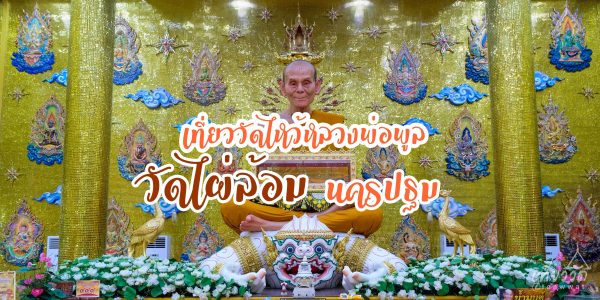
Luang Phor Poon (หลวงพ่อพูล, also written LP Poon or Luang Por Pool) was one of the most beloved Buddhist master monks of central Thailand: formally titled Phra Mongkol Sitthikan (Poon Attharakkho), he lived from 1912 to 2005 (BE 2455–2548) and served for some six decades as abbot of Wat Phai Lom in Nakhon Pathom province. He is famed as a master of loving-kindness (metta) and sacred inscription, for the takrut and Khun Phaen amulets he consecrated, and for the fact that his body did not decay after death — it rests today in a glass coffin at Wat Phai Lom, where devotees still come to pay respects.
Thai devotees gave him the epithet by which he is still invoked:
“Thep Chao Haeng Metta, Racha Khana Haeng Chok Lap” — the deity of loving-kindness, the lord of good fortune.
Who Was Luang Phor Poon?
Several Thai monks have carried the name Poon or Phool, but when devotees and collectors speak of Luang Phor Poon they almost always mean the master of Wat Phai Lom, Nakhon Pathom — the temple a short walk from the great Phra Pathom Chedi. His monastic name Attharakkho (อตฺตรกฺโข) means “one who guards himself,” and his royal ecclesiastical title was Phra Mongkol Sitthikan. He belonged to the same generation of celebrated post-war provincial masters as Luang Phor Koon Parisuttho of Wat Ban Rai, and like him became a refuge for people from every walk of life.
Early Life in Nakhon Pathom
Luang Phor Poon was born in November 1912 (BE 2455) — sources differ on the exact day, with both 5 and 11 November recorded — in Ban Don Yai Hom, Mueang district, Nakhon Pathom, the sixth child of Ju and Samniang Pinthong, a farming family. He completed fourth-grade schooling at Wat Huay Jorakhe school, and as a boy learned to read and write the sacred Khom (Khmer) script and studied traditional herbal medicine with his grandfather, Yaem Pinthong, becoming skilled in both while still young.
When he came of age he was conscripted and served from 1934 (BE 2477) as a royal cavalry guardsman with the rank of corporal — an unusual detail in the biography of a future master monk, and one his devotees remember with affection.
Ordination and Training
Wishing to repay the debt of gratitude to his parents, he was ordained on Sunday 9 May 1937 (BE 2480) at Wat Phra Ngam in Nakhon Pathom, with Luang Pu Suk of Wat Huay Jorakhe as his preceptor, receiving the name Attharakkho. He passed the first level of Dhamma studies (nak tham tri) in 1939 (BE 2482) and then turned to meditation, studying vipassana and the inner sciences as a disciple of Luang Phor Phrom of Wat Phra Ngam and of the great Luang Phor Ngern of Wat Don Yai Hom, one of the most revered monks in the history of Nakhon Pathom. When his foundations were strong he undertook years of solitary thudong wandering, practising in forests and mountains before returning to Wat Phra Ngam.
Abbot of Wat Phai Lom
Wat Phai Lom (“the temple surrounded by bamboo”) is believed to date from the reign of King Rama IV and is associated with the Mon community of Nakhon Pathom. By the 1940s it had long lacked a resident abbot. According to the temple’s account, villagers consulted Luang Phor Ngern of Wat Don Yai Hom, who pointed them to a monk of beautiful conduct at Wat Phra Ngam named Phra Ajahn Poon. In BE 2486 (1943) — some published accounts give BE 2490 (1947) — he accepted the abbotship of Wat Phai Lom, and he never left.
Over the following six decades he rebuilt the temple from a neglected, bamboo-choked site into one of the busiest monasteries in the province, raising the ordination hall, teaching meditation, dispensing herbal medicine and blessing the unbroken stream of visitors who came for his metta. He became renowned for hand-inscribed yantra — the slow, exact work of an old-school master — and his Saturday blessing ceremonies drew people from Bangkok and far beyond.
Amulets of Luang Phor Poon
Collectors prize Luang Phor Poon’s sacred objects for the meticulous way he made them: he inscribed takrut scrolls and yant himself, in the tradition he had learned from his teachers and from the old Khom manuscripts of his grandfather. The best-known categories include:
- Takrut — hand-inscribed metal scroll amulets for protection and fortune, regarded as his signature creation.
- Rian (coin) amulets and roop muean images — issued by Wat Phai Lom across many ceremonies from the later twentieth century onward.
- Phra Khun Phaen Kuman Sombat — the celebrated batch he consecrated from his sickbed on 17 May 2005, five days before his death, with a sacred thread (sai sin) linking the ceremony outside the ordination hall to his quarters.
- Kuman Thong Sombat and Hanuman images — traditions associated with Wat Phai Lom that his disciple and successor, Phra Khru Palad Sitthiwat (Luang Phi Namfon), has continued.
Because demand for his amulets has only grown since 2005, buyers should study references and deal with trusted sellers — the same discipline that applies to any classic amulet, as we explain in our Phra Somdej collector’s guide. You can browse our curated pieces in the shop.
His Passing and the Undecayed Body
After months of illness borne with remarkable composure, Luang Phor Poon passed away at 14:55 on Sunday 22 May 2005 (BE 2548), aged 92, in his 68th year as a monk. The day was triply auspicious: it was Visakha Bucha day, and it was also the day of Wat Phai Lom’s annual wai khru ceremony honouring the teachers of the lineage. Two days later King Bhumibol Adulyadej (Rama IX) graciously granted royal bathing water for the funeral rites and a royal gold casket — a mark of the highest esteem.
When the casket was opened at the hundred-day memorial rites, his disciples found the body whole and undecayed. It was placed in a glass coffin for veneration, and on 18 May 2019 (BE 2562) it was ceremonially enshrined in the temple’s Maha Vihara Buraphajarn, where pilgrims still file past daily. For devotees, the incorrupt body is the final proof of a life of purity; many pay respects, make merit and join the chanting there — you can follow the same traditional texts on our Thai Buddhist chants page.
Visiting Wat Phai Lom Today
Wat Phai Lom stands in Phra Pathom Chedi subdistrict, Mueang Nakhon Pathom, about an hour west of Bangkok, and is easily combined with a visit to the Phra Pathom Chedi itself. The temple remains highly active under Luang Phi Namfon, with regular consecration ceremonies, the annual wai khru festival each May, and a steady calendar of merit-making events in Luang Phor Poon’s memory.
Frequently Asked Questions
Who was Luang Phor Poon?
Luang Phor Poon Attharakkho (Phra Mongkol Sitthikan, 1912–2005) was the long-serving abbot of Wat Phai Lom in Nakhon Pathom, central Thailand. Renowned for loving-kindness, hand-inscribed takrut and powerful blessing ceremonies, he is one of the most revered Nakhon Pathom masters of the modern era.
Why is Luang Phor Poon’s body in a glass coffin?
When his royal casket was opened at the hundred-day funeral rites in 2005, his body was found undecayed. Disciples regarded this as a sign of spiritual attainment and enshrined the body in a glass coffin at Wat Phai Lom so devotees could continue to pay their respects.
What amulets is Luang Phor Poon famous for?
He is best known for hand-inscribed takrut scrolls, rian coin amulets, and the Phra Khun Phaen Kuman Sombat batch consecrated days before his death in May 2005. Wat Phai Lom is also famous for Kuman Thong Sombat and Hanuman images continued by his successor, Luang Phi Namfon.
When and how did Luang Phor Poon die?
He died peacefully at 14:55 on 22 May 2005 (BE 2548), aged 92, after a long illness. Remarkably, the day was both Visakha Bucha and the temple’s annual wai khru teacher-honouring ceremony. King Rama IX granted royal bathing water and a gold casket for his funeral.
Where is Wat Phai Lom and can visitors see him?
Wat Phai Lom is in Mueang district, Nakhon Pathom, close to the Phra Pathom Chedi, about 60 kilometres west of Bangkok. Visitors are welcome daily and may respectfully view Luang Phor Poon’s undecayed body in its glass coffin inside the memorial vihara.